

 Apple Podcasts
 Spotify
 Overcast
 PocketCasts
 RSS Feed
Can Australia Become A Clean Tech Superpower? Deep Dive Australia 05: Ross Garnaut
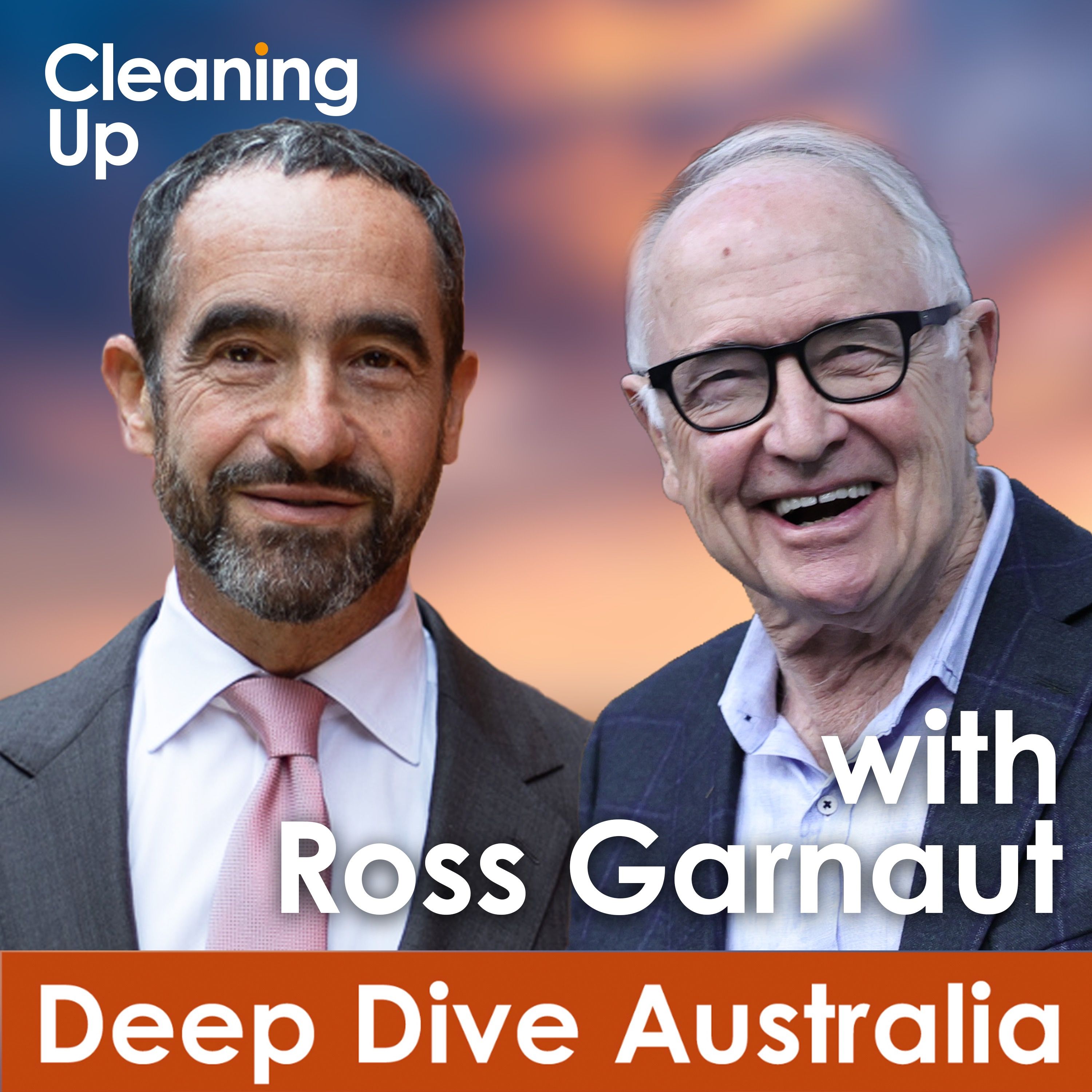
Across huge swathes of the global economy, clean solutions are already cheaper than their fossil alternatives, and so a carbon price isn’t needed. But in other sections of the economy, the costs of green tech are higher, and so carbon pricing will be needed to make them cost competitive. But what should that price be, and how can it be successfully implemented?
This week on Cleaning Up, Michael Liebreich is joined by Professor Ross Garnaut, a towering figure in the debate about how to implement carbon pricing, and founder of the Superpower Institute. Having advised successive Australian governments on climate policy since 2007, Ross makes the case for how Australia can export green iron, ammonia, and carbon-based fuels to industrialised economies that don't have the land or renewable resources to decarbonise on their own.
They discuss the political history behind Australia's stop-start carbon pricing, the debate over whether green hydrogen can ever get cheap enough to make the superpower vision work, and how First Nations communities are shaping decisions about the land at the centre of it. They also explore the tension between protectionism and genuine security concerns over Chinese supply chains, and whether China's undervalued currency is really what's holding back Australia's competitiveness.
Topics covered in this episode:
- Australian climate policy under different Prime Ministers
- Australia as a low-carbon superpower
- Exporting molecules vs exporting electricity
- First Nations involvement in land use
- The green hydrogen cost debate
- Protectionism vs. security concerns
- Pinning down an actual carbon price
- Trade imbalances and exchange rates
Leadership Circle:
Cleaning Up is proud to be supported by its Leadership Circle. The members are Actis, Alcazar Energy, Arup, Copenhagen Infrastructure Partners, Cygnum Capital, Davidson Kempner, Ecopragma Capital, EDP, Eurelectric, the Gilardini Foundation, KKR, Mitsubishi Heavy Industries, National Grid, Octopus Energy, Quadrature Climate Foundation, Schneider Electric, SDCL and Wärtsilä. For more information about the Leadership Circle, visit cleaningup.live.
Links:
- Watch our full Deep Dive Australia Series: https://youtube.com/playlist?list=PLc8cNKXCII70&si=GmXz-zQe3yK42V3o
- Ross Garnaut’s bio: https://www.rossgarnaut.com.au/
- Malcolm Turnbull on Cleaning Up: https://www.youtube.com/watch?v=t9CUGRHCswU
- Tony Abbott on Cleaning Up: https://www.youtube.com/watch?v=_39HmAgq9RY
- The Superpower Institute: https://www.superpowerinstitute.com.au/
- The SuperPower Institute reports: https://www.superpowerinstitute.com.au/work?type=report
- Ross' book — Superpower: Australia's Low-Carbon Opportunity by Ross Garnaut: https://www.blackincbooks.com.au/books/superpower
Ross Garnaut
The low carbon opportunity for Australia is that we have exceptional resources for solar and wind energy. We are the world's lowest cost in terms of the quality of resources location for very large quantities of renewable energy. We also have enormous capacity to produce at low cost biocarbon, which is the other essential ingredient alongside renewable energy for the low carbon industries of the future.
The highly industrialised, high income countries of the world, which are densely populated, don't have lots of land, first of all, the Northeast Asians, Korea, Japan, coastal China, but also China as a whole, Europe, will not be able to decarbonise from their own resources. Through international trade in zero carbon goods, they will be able to get to zero carbon outcomes at reasonable cost.
Michael Liebreich
Hello, I'm Michael Liebreich and this is Cleaning Up. We're recording this in Melbourne, which is the traditional country of the Wurundjeri Woi Wurrung people of the Kulin Nation. I want to pay my respect to their elders past, present and future. This episode forms part of our deep dive into the clean energy transition in Australia. We're recording it at the offices of our Leadership Circle member Arup, I'd like to thank the team here for all of their help and support.
In the more than two decades that I've been doing this, there has never been so much scrutiny of the cost of taking climate action. In huge swathes of the economy, the clean solutions are cheaper than their fossil alternatives, and so progress will continue without carbon pricing. But in other sections of the economy, carbon pricing will be needed because the costs are and in some cases will remain higher. My guest today has been a towering figure in the debate about how to implement carbon pricing for nearly four decades. As an academic, his influence has been immense and as an advisor to successive Australian leaders, he's played a huge role on the national and international stage. Here in Australia, he's the nearest thing climate economics has to royalty. Please welcome Professor Ross Garnaut to Cleaning Up. Ross, welcome.
RG
Good to be here, Michael.
ML
So let's start where we actually always start, which is you now get to describe your illustrious career, but we're going to need the very, very short version. But when did you first wake up to the issues around climate change?
RG
I was chair of the board of the International Food Policy Research Institute, which is a global research group based in Washington. And our serious work on food security in the developing world started to say in the first years of this century that the big threat to food security, especially in the poorer parts of the world, Africa and South Asia, the big threat was climate change. So that's when I first started taking it seriously.
I started making it a central part of what I did when all of the premiers of Australia asked me to do the climate change review on ANZAC Day 2007. And the Prime Minister was invited to join to make it a federal state exercise, he declined, but the leader of the opposition said that when he was Prime Minister, the Commonwealth would join. Since then, I'm afraid that it's been overwhelming in its demands and it's the main thing I've worked on. That's just the tail end of my career, I was 61 when I started on that.
ML
So you are this towering figure in climate economics and you started at 61. This is extraordinary news for me, I'm now 62. What you're saying is, I can have a whole second career after all this climate stuff. I could actually branch out, that gives me hope.
RG
Yes. If Australians talked about the Garnaut Report 30 years ago, they were talking about my work on Asian development, integration of the Australian economy into its Asia-Pacific environment, or they were talking about federal state relations or a range of other things. It's been climate since 2007.
ML
So we're going to get back to some of the issues that perhaps you would have been known for in the earlier part, the pre-age 61 part of your career, because I don't think that climate and climate economics and climate action, I've never thought that they can happen in a vacuum. And so I've watched the successive COPs where environment ministers go off and talk to each other and or perhaps some dedicated climate ministers. And I'm thinking this needs to be ministers of trade, ministers of industry, ministers of finance, and, of course, prime ministers or presidents. That's where the decision making really has to sit.
RG
I think that why I was asked to do this work by the premiers and the Prime Minister back in 2007 was that I was an economist interested in economic policy in general and especially international economic policy. Australians thinking about climate change then weren’t thinking of it as being an economic policy problem and an international economic relations problem.
ML
Yeah. And I just think we need to clarify because our audience, 12% of it are Australians, they'll understand all the Australia context and 88% will know very little. They will know that Australia's got lots of solar roofs or they will know that Albanese won three years ago and they haven't checked in since. So we just need to catch up. Premiers, when you say premiers.
RG
Australia's a federation and we've got sovereign state governments with lots of powers, lots of powers over energy in particular. The state premiers took initiatives on climate before the Commonwealth government was ready to. But it's an integral part of the Australian system as the states are in the United States.
ML
So these are state premiers and they were already presumably seeing the impacts and concerned about, because that's where the money is actually in terms of adaptation or in terms of mitigation, that money, they're being asked for money presumably, that's why they got interested first. And then the Prime Minister at the time, who would have been, was not interested. Who would that have been?
RG
John Howard at the time.
ML
Yeah, but then it was Rudd who came in, who did join that initiative.
RG
Yes. Rudd became Prime Minister in November 2007 and immediately my exercise became a federal Commonwealth state exercise.
ML
Okay. And if we then do something of a flyby or a fast forwards through the political eras, you were working there very closely. You developed a lot of work on carbon pricing and Australia's carbon pricing scheme and it all seemed to be going quite well for a while. Correct?
RG
Yes, initially there was a very broad base of support for action. All of the state governments, the federal government and the federal opposition. I would be meeting regularly with the leader of the opposition, Malcolm Turnbull, who has along his front bench, people like Tony Abbott, Ian McFarlane, all nodding when Malcolm said something. So it looked as if Australia was ready for action.
ML
We will put links in the show notes too, because two of the people that you've mentioned there, Malcolm Turnbull and Tony Abbott have actually been on Cleaning Up. So if anybody wants a bit more of a kind of insight into that, not just what they were thinking but also their personalities, then you can actually go to those episodes and it's pretty fun to look back and to actually get those characters, so yes.
RG
So the legislation implementing the recommendations that I'd made went through the House of Representatives. We've got a structure like the United States House of Representatives or Senate, we went through the House of Representatives. It was due to go to the Senate where the government didn't have a majority. The leader of the opposition, Malcolm Turnbull…
ML
Malcolm Turnbull was supportive of it?
RG
Was saying we're going to pass this in the upper house. But the day before the legislation went to the upper house, he was defeated by a single vote in the Liberal Party room by Tony Abbott. And so things stopped. That seemed to be the end of things for a while, but we ended up with a hung parliament, no side having a majority after the elections in 2010. And the people who held the balance of power, especially two independent members of the House of Representatives, said who they made prime minister depended on their action on climate change. So I was brought back in to do it all again. This time the government was able to put together a majority in the Senate and the world's best set of climate change policies was legislated.
ML
And that's the end of the story. And they lived happily ever after.
RG
Yes, happily ever after until Tony Abbott became Prime Minister after the election in 2013. Tried to abolish every bit of the climate infrastructure, tried to abolish the Climate Change Authority, the Renewable Energy Agency, which was supporting innovation in renewable energy, the Clean Energy Finance Corporation, which was funding the climate energy projects if there was zero carbon, carbon pricing. But he didn't have the numbers in the Senate to get rid of it all, he thought he did. We had an entrepreneur who bought four Senate seats in the 2013 election who said he was going to pass it all. But he spent a day talking to Al Gore and decided he'd only pass the repeal of carbon pricing, but would block the repeal for everything else. So we kept, well, the Renewable Energy Target most importantly, but these other institutions, they survived the Tony Abbott repeals.
ML
It's an extraordinary story of individuals and near misses and so on. But unfortunately we won’t be able to go through the rest of history, because obviously there was the Scott Morrison years and then there was the victory by Albanese and we've got now a set of policies at the end of that, but not carbon pricing.
RG
No, we basically got the Tony Abbott policies which were introduced to look as if you were doing something while making sure you weren't doing anything. Now we've strengthened them somewhat, but there's still the Tony Abbott framework governing Australian climate and energy policy.
ML
But you do have, you have this thing that's come up in a few of the episodes of this Deep Dive so far, the safeguard mechanism. I mean, that's a kind of carbon pricing system, is it not?
RG
Yes, it is. It's a Tony Abbott type of carbon pricing system. It was designed not to have much effect and it's very successful in achieving its objectives.
ML
Okay, what we're going to do, I think there's broadly three areas that I think we should spend time on in our conversation. The whole, you know, the area of carbon pricing and what you need and how it works, which I'm not sure that we have a stomach for too much detail. But you've also, you now run this thing called the Superpower Institute and I should plug your book, that's the way we do things around here. There we go. I'm going to hold it up for the live audience and the YouTube audience. The podcast audience will have to just accept that there's some performative dance with the book going on. And it's called Superpower, Australia's Low Carbon Opportunity. And the first one came out I think in 2015 and you've done some updates since. But that then turned into an institute, what does the institute do?
RG
Well, to start with, I don't run it. In the audience, Baethan (Mullet) runs it and does it very well. And we've got brilliant young people doing clever work that are beyond my current capacities, I'm there to give them a hand. But the low carbon opportunity for Australia is that we have exceptional resources for solar and wind energy. We are the world's lowest cost in terms of the quality of resources and location for very large quantities of renewable energy. We also have enormous capacity to produce at low cost biocarbon, which is the other essential ingredient alongside renewable energy for the low carbon industries of the future.
The highly industrialised, high income countries of the world, which are densely populated, don't have lots of land, first of all, the Northeast Asians, Korea, Japan, coastal China, but also China as a whole, Europe, will not be able to decarbonise from their own resources through international trade in zero carbon goods. They will be able to get to zero carbon outcomes at reasonable cost, run as autarkies, self-sufficient in energy. They'd be no more capable of getting to zero carbon while maintaining high living standards than they would be if they had to be self-sufficient in the fossil carbon economy. International trade is going to be as important in the zero carbon economy as in the high carbon economy. Australia is exceptionally well endowed to supply zero carbon goods to that world economy.
ML
So, and that completes my earlier sentence. There's three things. I think there's the carbon pricing and how we do that, how we get those externalities priced. There's the superpower thesis of Australia as an exporter into those markets. And then the third one is really the macro implications, trade, interest rates, exchange rates, which I'd like to get onto as well. Maybe harking back to some of that earlier part of your career. Let's go into that superpower thesis, because what a lot of people focus on, and particularly recently, it's been fuels and hydrogen and so on as a way of supplying those countries. But you put carbon in as an essential part of that trade, carbon molecules. So, can we unpack that a little bit? And I would then ask as you do that, why not electricity? You focus so much on trading the fuels and carbon molecules, but not on electricity. Why is that? Give us the whole thesis.
RG
Yeah. I'll just take one industry to begin and then generalise from that. Just take iron steel, it accounts for about 9% of global emissions. Nearly 8% of global emissions are just a conversion of iron ore into iron metal. We do that with metallurgical coal or natural gas, using the carbon in coal or the carbon and the hydrogen in natural gas. And in that world, Australia has the world's richest resources of iron ore and metallurgical coal, but it doesn't cost much to shift metallurgical coal from Australia to Kobe or Shanghai or Busan. And so, Japan, China, Korea make most of the world's steel between them by taking Australian metallurgical coal and Australian iron ore and putting them together there.
The cost of metallurgical coal from Queensland or New South Wales in Australia is just 5% higher than the cost in Australia. And their greater efficiency in manufacturing means that it makes sense to take the coal there. For electricity to move from Australia under the ocean to these places, or even closer places like Singapore, it's just much more expensive. It doesn't add 5%, it would probably double the cost of movement of the energy. That led some people to think, well let's move hydrogen like we move natural gas. Well, hydrogen is much more expensive to transport than natural gas.
ML
I'm going to say, is that right? Because my audience will know that I've done a lot of work on hydrogen, so yes.
RG
Yeah. Well, for the 1% of the audience who doesn't, it won't liquefy until you get almost to absolute zero. So, you use nearly half the energy in the hydrogen just to liquefy it. And then it's the smallest atom and molecule that seeps out between steel structures so you have to have special material, just very expensive. So, hydrogen from Australia, instead of being 5% more expensive in Japan or Korea or China than in Australia, it'll be more than twice as expensive. They will not remain internationally competitive manufacturers using steel if they take Australian hydrogen there and turn it into iron there. They will lose their competitiveness in the steel-based industries, which is a lot of manufacturing. By importing iron converted from hydrogen and iron ore in Australia, they can remain globally competitive in all of those industries that use steel.
ML
So, the superpower thesis though is to do that in Australia, to do the reduction in Australia.
RG
Yes, because you don't have the high cost of transporting electricity and hydrogen.
ML
Okay, but then exactly what is Japan, Korea, what are their steel industries going to do, because that's now moved? What you're saying is those industries will move to Australia.
RG
Well, there's only a tiny part of the value added in a Toyota truck that represents the value added in the iron making in Japan. So, they lose a tiny bit of the employment, a tiny bit of the value added, and by using low-cost green iron from Australia, they will remain competitive in the rest of their manufacturing supply chain.
ML
But their politicians will have to explain that those blast furnaces that are, and politicians by the way I don't know if you've noticed this, but politicians all have blast furnace fetishes, at least those in countries with blast furnaces do have those fetishes. In the UK, the last one is just shut and I can tell you it's not good enough just to say, oh, well it's only a few thousand jobs. That doesn't work politically.
RG
Getting rid of the high cost of protection is always a challenge for a government, and good governments do it in the interests of their people.
ML
Okay, so you're confident that that part will work?
RG
No, I'm not confident. It'd be hard work, but I know it's possible. When I was ambassador to China in the ‘80s, my big job was to talk to the Chinese leadership about how they could achieve their economic goals if they used low-cost imported iron ore. When I became Ambassador, China was pretty well self-sufficient in iron ore, using rubbish iron ore, 30% iron ore. I was saying to the Chinese leadership, for you to achieve Deng Xiaoping's goal of quadrupling your output by the end of the century, all the capital in the world won't be sufficient to make the steel you need if you keep using your rubbish iron ore.
Eventually, they got the point. The two million people employed in iron ore mining did other things. Their anxieties about being dependent for strategic material on a country allied with the United States became less important than achieving their development goals, and so they took that big decision. The movement from dependence on iron ore imports to iron metal imports is very small compared with the movement from self-sufficiency in iron ore to being very dependent on Australian iron ore.
ML
Shall we look at ammonia as well, fertiliser, because that's another good example. Otherwise, this becomes all about steel. What is the superpower thesis around fertiliser, around ammonia?
RG
Ammonia is cheaper to transport than hydrogen, even with the cost of making the ammonia and then taking the hydrogen out at the other end. There'll be some trade in ammonia for energy, especially for countries with the weakest endowments of renewable energy, Singapore, Taiwan, with no capacity to make renewable energy. But the main game…
ML
I want to park that, because on that $400 per megawatt hour, Singapore could afford it, but I don't think anybody else can.
RG
Taiwan, yeah.
ML
Possibly, it depends on the value added. Let's park that one, because I don't want to go down too much of a hydrogen rabbit hole, but we probably will anyway.
RG
The big trade will be in the use of ammonia in chemicals, especially fertiliser. The world is able to feed itself because of its use of nitrogenous fertilisers. Historically, they've been made from coal or gas with huge carbon emissions. In the zero-carbon world, urea will be made from green ammonia, made from renewable energy, plus biocarbon. Australia has rich resources of the biocarbon and the renewable energy to make the renewable green ammonia.
ML
It'll be green ammonia and green urea using an Australian carbon molecule, because urea has carbon in it.
RG
That’s right.
ML
Let's just touch on that carbon point. Where is the Australian carbon molecule in this scenario? We're moving reduction of iron and we're moving the production of ammonia to Australia, but then we've also got other fuels, which you've got urea and then other fuels that will be using Australian carbon atoms. Where are they going to come from?
RG
We're already a pretty big producer and exporter of carbon atoms in food and fibre, but there's a very large area...
ML
Biogenic carbon atoms. We're not talking about the Australian coal carbon atoms or gas carbon atoms, just to clarify.
RG
That was trees a few hundred million years ago. There's nothing that fossil carbon can do, nothing that trees a hundred million years ago can do, that trees today can't do. You can get exactly the same chemical properties for a biodiesel, a sustainable aviation fuel, a methanol for shipping from today's plants as you can get from plants a hundred million years ago that have turned into coal. But the fresh carbon in Australia can come from sustainably growing and harvesting plants on the very large areas of Australia that have potential for this, but which are not currently used for high value agriculture, not currently used for high value food production.
ML
Type of crops?
RG
Probably the indigenous Australian acacias and eucalypts are going to be dominant. They've got a number of features that make them particularly suitable. Now we've never thought of these as economic crops, so there's a lot of research and development needed to get the best out of them, just as all of Australia's current agriculture depends on the huge investment governments made in research and development to adapt European farming systems to this very different environment.
ML
Have you or your team, we've got some of the reports here by these brilliant, I'm not going to do the whole performative dance thing, but there are these reports, and by the way I've read a couple of them and they are incredibly good, they're incredibly filled with the key information that you need, but I didn't have time to find, do you know what area of Australia needs to be devoted to those crops in order to meet the need for the global need for the carbon molecule, the carbon atom?
RG
Well Australia won't alone supply the whole of the world's requirements. We think that economically, goods from Australia being exported to the rest of the world can reduce global emissions by about 8%, so we're 8% of the world's story, but it's the hardest 8%.
ML
I was just worrying about the land use change, the risk of unintended consequences, you know in Europe everybody thought, oh we'll do biodiesel, it's a tremendous idea, and of course that ended up wiping out huge swathes of land in places like Malaysia for palm oil.
RG
And it was our work at the International Food Policy Research Institute in Washington that actually identified that problem, so I'm very familiar with that.
ML
First pushed for that solution and then identified the problem, to be completely fair. The biofuels as a solution also came out of that environment, right?
RG
That's right, and the problem there was in looking partially at a particular solution, not having economy-wide carbon pricing, but Australia has about seven and a half million square kilometers of this range land which is currently not used for high value agriculture that could be used for sustainably growing biomass. We're probably talking about a hundred million of those, and we would be growing more sustainably, more of what is growing now, and that could probably make Australia's contribution to the 4% or 5% of global emissions that come from liquid fuels, fertilisers requiring biogenic carbon that we could produce.
ML
Can I ask you though, because I'm an outsider to this, but I do know that every acre is valued, particularly valued by the First Nations people, and when I listen to this it sounds like, well it's low value and so we should do this, and it all is a little bit, there's a saying in French, “de haut en bas,” from up above to down below, to the people on the ground. Is that a valid criticism, or what would you say to the First Nations people about wanting to use large volumes, large areas of land for this use?
RG
I'm much more interested in what they say to me than what I say to them.
ML
What do they say?
RG
When I was doing my first climate change review, I had large groups of Indigenous Australians coming to me, talking about how they could use their land at high value, with themselves being in control to produce these things. It was my recommendations that led to the use of savannah burning, which is an Indigenous Australian technique that can increase the carbon, the concentration of carbon in plants in Northern Australian environments. And so long as we recognise that Indigenous Australians want to be in control of what happens on their land, then they will lead us into that. If we treat them as, unfortunately many Australians do, as just passive recipients of some income from things that others do, we won't get very far. But treat Indigenous Australians as the leaders of this effort, and we'll get a long way.
ML
So can I ask a cheeky question then, in the Superpower Institute, how explicitly are the First Nations Indigenous people involved in, how many of the authors of these reports are First Nations, are from that heritage?
RG
Not authors of these reports, but regular visitors to our office, which you visited in Fitzroy, you've got to walk up four steps of the stairs. The leaders of the Indigenous community interested in carbon farming of this kind, in the centre of Queensland, have walked up those stairs and talked for days to us about these things.
ML
The Institute is in a wonderful former tea warehouse, which I walked up the stairs and I said this was a tea warehouse, because it's so characteristic. But that's good to know. Look, I'm asking the cheeky question I think, because the audience would want me to, because it's absolutely critical that the custodians of the land are fully involved.
Cleaning Up is proud to be supported by its Leadership Circle. The members are Actis, Alcazar Energy, Arup, Copenhagen Infrastructure Partners, Cygnum Capital, Davidson Kempner, EcoPragma Capital, EDP, Eurelectric, the Gilardini Foundation, KKR, Mitsubishi Heavy Industries, National Grid, Octopus Energy, Quadrature Climate Foundation, Schneider Electric, SDCL, and Wärtsilä. For more information on the Leadership Circle, please visit cleaningup.live.
To keep up with all that's going on in the Cleaning Up universe, make sure you subscribe to our newsletter. Written and edited by my longtime New Energy Finance and BloombergNEF colleague, Angus McCrone, it comes out every second Monday. Angus provides the latest on the episodes we're recording, the events we're hosting, stories we're watching and what Bryony Worthington and I are up to. To sign up for the Cleaning Up newsletter, visit cleaningup.live.
So let's go to the vision of these economies, these industries, as you're proposing. You've got a big industry that's producing iron and another one that's producing ammonia and another one that is farming and harvesting the carbon and then turning that into fuels or into using it for the urea. It needs a lot of hydrogen, we're going to have to go there. And you're very sure that hydrogen, because we spoke a little bit in prep for this, you're very sure that hydrogen will be green and it'll be really, really cheap. And I think that's probably where I would diverge. I don't think that the green is going to be very, very cheap.
RG
You've done thermodynamics at Cambridge and you talk like a scientist or an engineer. I'm an economist, so I'm not certain about how anything will turn out. I want markets to determine what is the low-cost way of producing green hydrogen. I want a carbon price, I want support for innovation. There'll be competition in that world between hydrogen made from renewable energy and electrolysis, with hydrogen made from natural gas sequestering the carbon in geological structures. I myself, from what I've seen, think that the green hydrogen made from renewable energy looks like it will be much cheaper, but I don't want to say it has to be that. I want a carbon price, I want financial support for innovation and let the low-cost technology reveal itself.
ML
So, I was going to try and get in there because you said, I can't remember the exact phrase used, but it was the markets to show in a sense which way of making green hydrogen is the cheapest, but then you rescued it by saying, it could be essentially blue hydrogen, because we had this conversation in the preparation. I think we do diverge though because I don't think that green hydrogen, the electrolyser piece of it will go down a learning curve just like solar and just like batteries, but so much of the green hydrogen value chain is actually heavy engineering. It's substations, it's pumps, it's pipes, it's tanks, it's civil engineering, it's blast walls, it's heat exchangers.
Yes, I'm talking like an engineer, but I'm talking like an engineer with some scar tissue from having also been very excited about hydrogen for a short period and then realising just how darn expensive the stuff is. By the way, there's one thing I have to also bring up, which is in this report which is November 2024, about your costs of renewable energy in Australia, you've got one chart where you've got wind and solar at about AU$50 per megawatt hour. I've just recorded an episode with Paul Simshauser, Professor Simshauser, and right now wind in Australia costs AU$120 per megawatt hour, not AU$48, I think, as it's got in this report, but AU$120. So it's not just the hydrogen processes that might be more expensive, you've now had quite considerable inflation in the costs of renewables. Solar has remained at about the same cost as in here. The inflation hasn't hit it the same way, but wind has become really quite expensive here.
RG
That's wind the way we do it in Australia. That's wind tied to the existing networks to supply the cities, basically. That's what Paul's talking about. We're world champions at making engineering expensive. Sure, we've invented ways that the rest of the world's never heard of to turn excellent wind resources into AU$120 per megawatt hour, but Australia is not going to make it as a continuously prosperous democracy unless we become better at doing things. We were better a generation ago at these sorts of things, and we rescued ourselves a generation ago from a long history of protection.
We've slumped back into very high cost ways. We've made things more expensive too by making it very difficult for us to use the low cost Chinese supply chains. We're going to have to be cleverer at a number of things, but you can be clever about a number of things to use Australia's advantages if you're working on a very large scale and developing wind and solar for these industrial uses. Incremental add-ons to the existing system are truly expensive. That's an Australian genius for regulatory complexity, but we don't have to constrain ourselves with that for the new industries.
ML
But it does mean that for that vision of those industries that we laid out, that you've got a number of things you have to believe. So you have to believe that hydrogen, whether it's blue or green, has to become very, very cheap. And if it's going to be green, then the wind has to become very, very cheap, which means that Australia's way of doing engineering has to become very, very cheap. And also, you have to get over issues around reliance on China, which also have political costs and real concerns here in Australia. So it's becoming, is it not, just ever so slightly improbable that all these things will line up, and we haven't even talked about carbon pricing yet.
RG
Certainly there are some challenges. And we're not doing very well, we're not doing very well at using our endowment for our own decarbonisation or for building the superpower. We're going through a pretty poor period of public policy in general, but in this area in particular. But we are world leaders in low-cost, large-scale engineering in a number of areas. Those mining projects in the Pilbara producing most of the iron ore used to make steel in China are by far the most efficient, lowest cost, big mining systems in the world. It's not that Australians are genetically or culturally incapable of first-rate engineering performance. We do it.
We were doing it very well with the established producers, and then a new one came along, Fortescue, using poorer ores but finding its cost lower than the others because it was very efficient at using low-cost engineering systems. The challenge with use of the Chinese supply chain is we've just got to become clever at identifying what are the essential security constraints that are important geopolitically, and we can look after those issues if we're clever while retaining access to world-class engineering.
This is a really fundamental thing. When my Superpower book first came out, I've been quite close to the leaders of Rio Tinto since the mid-70s, and so some of my friends in the headquarters, the brain centre of Rio Tinto, used to be CRA, used to be the other end of the street in Collins Street, now it's in London. It doesn't work quite as well now, but the leaders of Rio Tinto said to me when the book came out, yes, the zero-carbon economy is going to create superpowers in energy. The world's going to need them, but it won't be Australia because Australia has cut itself off from the Chinese supply chain. It will be belt and road countries, and I said we're cleverer than that. We'll be able to look after our security interests while retaining the benefits of the Chinese supply chain in the areas where there's no real security conflict. So far we haven't done it, but we're not incapable of it.
ML
The context here is Europe has just banned the use of Chinese inverters for solar farms, for solar panels in Europe. The thinking being that inevitably the inverter, the controls of the inverter enable people to switch off, if they want, that resource. And so having an energy system which can be switched off from Beijing, Europe has just said that just can't happen. Now there are European inverter manufacturers, but they're much smaller and they're not as competitive. And so there are these security issues that translate into costs, they just do.
RG
I don't think Europe's being very clever about that, and the reaction against use of Chinese EVs is pure protectionism. They've let themselves get into a position where they're no longer efficient at making cars, and it's pure protectionism driving the motor vehicle constraint. If we, a small economy or medium-sized economy like Australia, let ourselves be governed by protectionist attitudes, then we won't be the superpower, we won't even be a middle-income developed country.
ML
I promised we'd get onto macro, let's get onto that, because on the protectionism I sort of 90% agree. The UK, by the way, has not put the tariffs on Chinese cars and they're flooding into the country. I think that there are real concerns around security, I don't think you can brush them off by saying it's pure protectionism.
RG
I'm not brushing it off in general, I'm saying there are specific things you address the specific problem and don't use it as a blanket protectionist.
ML
The carbon price question. These industries, these new industries, superpower industries that you've proposed, they work if there's a carbon price. This is not cheaper than in the case of steel, blast furnace, coking coal steel, in the case of ammonia or urea, just making it out of natural gas or coal, aviation fuels. There's no scenario where a sustainable aviation fuel is going to be the same or even close to the cost of a kerosene jet fuel.
So, you need a carbon price and you're going to be in competition as you try and build those industries with countries, not just China, Indonesia, Malaysia, Philippines, lots of countries that are simply, frankly, not going to have a carbon price. Or if they do, it's going to be $10 or $20, some token carbon price. Even the Chinese carbon price that exists now is still token at the moment, not sufficient to drive those industries. And even the European carbon price at €75 euros or €70 euros, whatever it is today, is insufficient to provide the price umbrella to create those industries. So, isn't this all just kind of theoretical?
RG
Oh, we do need a carbon price. And this is the economist versus the engineer or scientist again. The economist says in advance we can't predict what's going to be cheaper and more expensive. When I did my original big climate change review, it looked as if renewable energy, solar and wind, was going to be permanently more expensive. So, you had to have a carbon price just to...
ML
Well, this engineer didn't agree with that.
RG
Well, good on you. But as an innocent economist, I spoke to everyone in the world at the frontier of solar energy, including in Britain, in America, in Germany, in Brussels, in Beijing, in Tokyo, in Seoul.
ML
I sat by the phone! I sat by the phone, waiting for that call. Actually, selling information to a bunch of people who are acting on it. So, there you go.
RG
And now, what happened was that once we started producing at scale, and it was the European carbon price that got it going, where you had...
ML
No, sorry. It was the German feed-in tariff that got it going.
RG
Well, the combination of the two, they both helped. The German feed-in tariff is very powerful and a version of it...
ML
The carbon price was €5, €7 for much of the time. It was the German feed-in tariff that really got it.
RG
That was a big thing. And that created a market and you started to get scale production, costs came down. We did not know in advance the costs were going to come down. They won't come down for everything, there'll be some things that will be very expensive. And so, what the carbon price you need is, the social cost of carbon is the price of carbon that gives you net zero in 2050, if that's the objective that we've decided is necessary to achieve the world's climate stability. And of the 100% of things that we use now, or that we used in say, in 2007, maybe 60% or 70% of those will turn out to be cheaper after all the innovation. 30% or 40% may turn out to be much more expensive. The carbon price has to be high enough to get to net zero in those conditions.
ML
Let me ask, what is that carbon price? Let me give you a data point. Harvard economists Shafiee and Schrag 2024, said that for steel, it would need to be $500 US. They have a range which goes from about $250 to about I think it's $750, median $500 per tonne of CO2 to do green steel. Is that right?
RG
If the United States is protectionist and self-sufficient, that may be necessary. And under Trump's America, that may be necessary. But Australia can produce green iron and green steel at a much lower, at the European carbon price. So it depends on your openness to foreign trade.
ML
So you're uncertain about how, because you're not the engineer, you're the economist, you're being uncertain, but you're very sure that it will happen and it'll be at the €70, you know, what is that? $90, so $90 or $100 per tonne of carbon will get this whole plan done, including the fuels and the steel and the fertiliser.
RG
No, no, it'll be different for different things. You made the point about iron and steel. I happen to have done a lot of work on that, the Superpower Industry has done a lot of work on that.
ML
But based on a wind power price of $48 Australian dollars per megawatt hour, which nobody is achieving.
RG
Some people are achieving it, but it's not being achieved in…
ML
In China, but isn't your problem fundamentally that in China, they've got the costs down, but no carbon price. And here you've got the costs that are high and you may have a carbon price depending on political winds of change.
RG
If we continue to have the highest cost engineering in the world for these industries, not for everything, then we won't play this role in the world economy. Australia can change, can do things better. We changed in mining. We're the world's most efficient producer of big engineering. We've got to do that for this industry. Much harder than introducing carbon pricing in Australia was getting rid of Australian protection in the 80s. We loved it, we loved protection. And there was never a majority support for it, but we had to get rid of it for Australians to be prosperous. I was Bob Hawke's economic advisor when we got rid of protection. It was a harder one than this. It was impossible, but it was done because the advantages to Australians were studied and turned out to be understandable.
ML
So we need the carbon price and we need effectively what you're saying is a massive focus on productivity in engineering in these industries. I promised we'd do macro, that's quite a bit of macro but there's one other area, which it just strikes me, well, I have a question. It's not that it strikes me. I'm going to pose it truly as a question because I don't have the answers. Exchange rates, isn't it just fundamentally the problem that China is so cheap right across the board, they've got scale and they're so cheap across absolutely everything. And they're obliterating. So you have also, we haven't talked about the extractive industry where Australia should be competitive, but isn't not because of lack of engineering or productivity, but because China owns the smelting and the processing of all of these minerals.
But you can't, in my understanding of competitiveness, of Adam Smith and competitive advantage, you can't have an advantage across everything. Otherwise, eventually you have all the money and nobody can buy anything from you. So isn't there an exchange rate adjustment at some point that the yuan is just too cheap or our currencies are too expensive? And isn't that the way to solve some of these problems, which will be, how can I put it, seems less improbable than the carbon price and the dramatic jumps in Australian productivity.
RG
I think China should have a higher real exchange rate. Another way of putting that is that at current levels of productivity in China, the Chinese people should be richer. Real wages have been rising in China since 2005, 2005 was the turning point in economic development when you use the cheap surplus labor from the countryside and so you had to raise wages to attract people into new employment. It's been rising by about 5% per annum in real terms since then. But they should have been rising at 10% per annum or more. The Chinese people have earned a higher level of incomes and consumption than they're currently getting. As a result, China has by far the largest trade surplus that the world has ever seen.
I think it would be better for the people of China, certainly better for the people of the rest of the developed world, if China accelerated the growth in living standards within China. It's already more rapid than other places in the world, probably than anywhere in the world, the growth in living standards. But the living standards should be rising more quickly. That will raise the real exchange rate, either through inflation or currency appreciation, doesn't matter which way it comes. And that will make China less competitive in everything. But it will remain the most competitive place for a wide range of goods. But it will start being a bigger importer of the things it's least competitive in. And that will be very good for development everywhere.
Now, that's only part of the story. The other part of the story of the Chinese surplus is that it has become a very big investor in the rest of the world. In this, it's really the fourth time since Adam Smith that one country has started to play such a big role in capital exports to the rest of the world. You had Britain up until the First World War, you had the United States and the dollar surplus of the first decade, well first one and a half decades after the Second World War. You had Japan in the ‘80s. Now you've got China. Now, China happens to be proportionately bigger.
There are benefits from the export of capital that's being especially important in the developing world. Pakistan is very rapidly decarbonizing on Chinese capital imports and Chinese equipment. But it would be a better balance of policies for China to have a more rapid increase in living standards to be importing more. That would take some of the pressures off trade with Europe. That is the announced policy of the Chinese government to do that. But they have not moved as quickly as in their own interest. I think the Chinese Communist Party's legitimacy at home would be even greater if it was increasing the living standards of the Chinese people more rapidly.
ML
Of course, there's two sides to an exchange rate. There's also devaluation of the non-Chinese or the Australian, in this case, exchange rate. Of course, whichever way it's done, if the Chinese yuan exchange rate goes up, that also makes Chinese equipment more expensive in Australia. So then those numbers would need to be, again, re-evaluated. That $48 will not be possible.
RG
Well, this is a complex story. There's Australian value added, about half the cost of the supply chain is Australian value added. So that balances out, actually.
ML
Ross, it is fascinating to talk to you. As you can tell, I'm bombarding you with questions, that doesn't mean I disagree either with the goal or necessarily with all of the elements of your superpower thesis. But I enjoy challenging it and having the conversations. It's been absolutely tremendous. And I'd like to thank you for your time today, coming on the show.
RG
Good to have you here in Australia.
ML
Thank you. So that was Ross Garnaut, a towering figure in economics, in climate economics, and now the founder of the Superpower Institute, exploring ways that Australia can dominate some of the new industries of the future and benefit from them as their exports in coal and natural gas will inevitably decline. We'll put links in the show notes as always to resources that we mentioned during our conversation. There's too many to mention here, but certainly some of the Superpower Institute reports and the previous episodes with Tony Abbott and Malcolm Turnbull. And with that, I'd like to thank Jo Jagger and Kendall Smith, our head of operations, for organising this extraordinarily complex tour of Australia. Our producer Oscar Boyd, our video editor Jamie Oliver, our cameraman here in Melbourne, that's Matt.
Also, the Leadership Circle for making all of this possible, and in particular, Arup for the use of their offices, and you, the audience, for spending time with us today. Make sure that you've subscribed to our newsletter at cleaninguppod.substack.com so that you don't miss the next episodes of this Deep Dive into Australia or any of our normal Cleaning Up episodes. And with that, thank you once again. For more information on the Leadership Circle, please visit cleaningup.live. If you're enjoying this episode, please hit like, leave a comment, and also recommend it to friends, family, colleagues, and absolutely everyone. To browse our archive of around 250 past episodes and to subscribe to our free newsletter, visit cleaningup.live.
Co-host, Cleaning Up Podcast
Michael is an acknowledged thought leader on clean energy, mobility, technology, climate, sustainability and finance. He is Co-Managing partner of EcoPragma Capital and CEO of Liebreich Associates. Michael is also co-host and founder of 'Cleaning Up' a podcast and YouTube Series.
Former roles include member of the UK’s Taskforce on Energy Efficiency, chairing the subgroup on industry and an advisor to the UK Board of Trade, an advisor to the UN on Sustainable Energy for All, and a member of the board of Transport for London. He is also the founder of and a regular Senior Contributor to BloombergNEF.


