

 Apple Podcasts
 Spotify
 Overcast
 PocketCasts
 RSS Feed
The Era Of Fossil Fuel Unreliability Has Begun | Ep 254: Jennifer Granholm
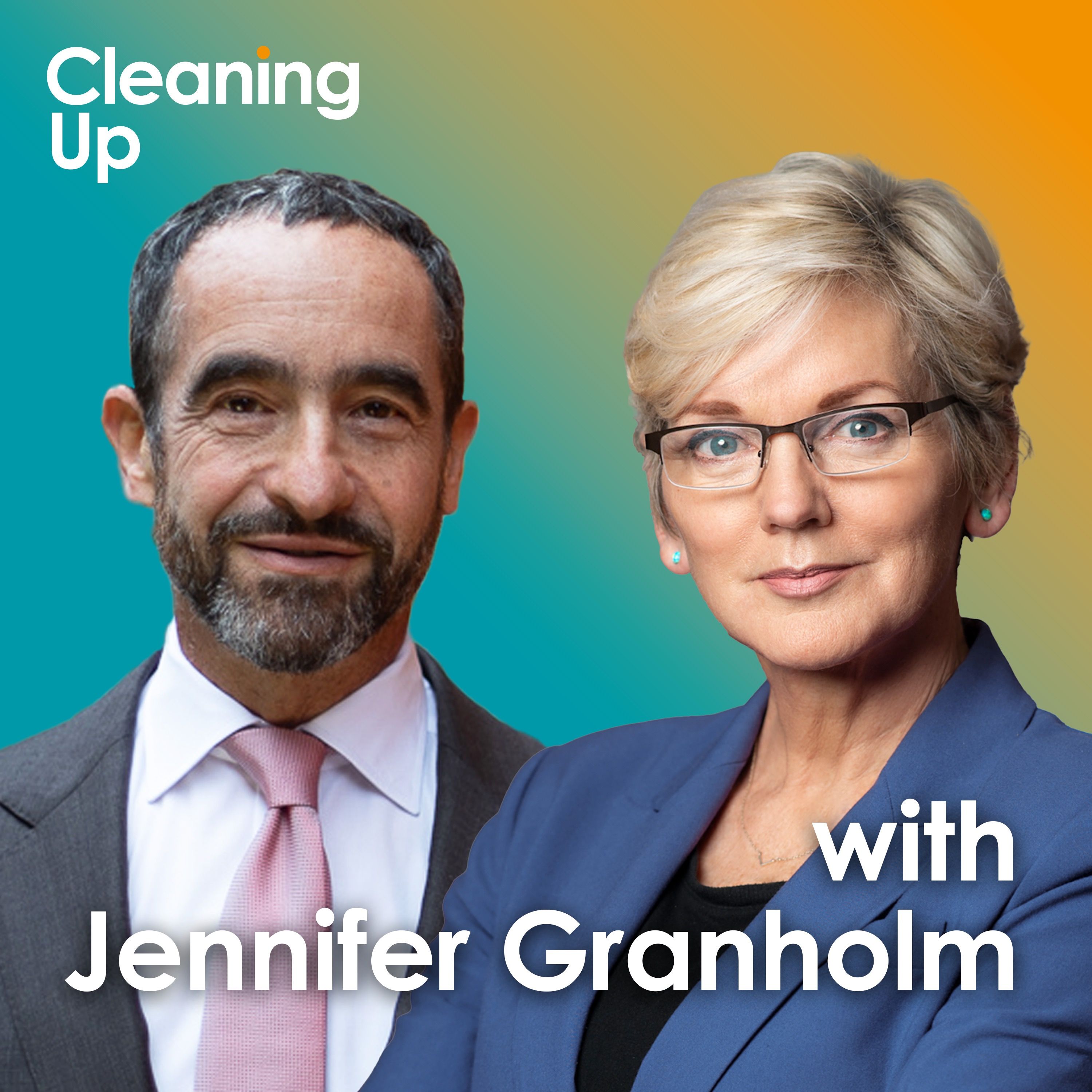
What happens when global energy supply chains can no longer be trusted? Has the U.S. given up its edge in the clean energy race to China? And can politics keep up with the speed of the energy transition and the rise of AI?
This week on Cleaning Up, Michael Liebreich sits down with former U.S. Energy Secretary Jennifer Granholm for a wide-ranging conversation on the future of global energy, politics, and clean technology.
They explore how geopolitical tensions, from disruptions in the Strait of Hormuz to shifting alliances, are reshaping global energy markets and accelerating the move away from fossil fuels. Granholm offers an insider’s perspective on the impact of U.S. policy decisions under both Joe Biden and Donald Trump, including the rise, and partial dismantling, of the Inflation Reduction Act and what that means for US clean energy investment, manufacturing, and competitiveness.
The discussion dives into the growing divide between ‘petrostate; U.S. and ‘electrostate’ China, the global race for dominance in electric vehicles and battery storage (with companies like BYD leading the charge), and the unintended consequences of tariffs and industrial policy.
Looking ahead, Granholm reflects on lessons learned from her time in office, what a future Democratic administration might do differently, and the political and economic challenges shaping the road to the next presidential election 2028: inflation, energy affordability, and the disruptive impact of AI on jobs.
Leadership Circle:
Cleaning Up is proud to be supported by its Leadership Circle. The members are Actis, Alcazar Energy, Arup, Copenhagen Infrastructure Partners, Cygnum Capital, Davidson Kempner, EcoPragma Capital, EDP, Eurelectric, the Gilardini Foundation, KKR, Mitsubishi Heavy Industries, National Grid, Octopus Energy, Quadrature Climate Foundation, Schneider Electric, SDCL and Wärtsilä. For more information about the Leadership Circle, visit cleaningup.live
Links and more:
- What Democrats Can Learn From the Trump Energy Playbook: https://www.bloomberg.com/news/articles/2026-01-26/jennifer-granholm-democrats-should-use-trump-playbook-for-climate
- For Real Energy Dominance, We Need the IRA: https://heatmap.news/ideas/energy-dominance-ira-granholm
- Can Data Centres Play Nice With The Grid? Varun Sivaram & Steve Smith: https://www.youtube.com/watch?v=4kSrgRZUCwE
- The Future of Clean Tech Under Trump — Ep198: Jigar Shah: https://youtu.be/PCOaF-qQ_TU
- Why Renewables Are Booming Despite the Politics | Ep245: Miguel Stilwell d'Andrade: https://youtu.be/5oL_XlZ8k_M
- How the US Lost The Race for Clean Energy | Ep 219: Ethan Zindler https://www.youtube.com/watch?v=YQLkLXt9Uek
ML
It just feels like the US has taken itself out of competing for those markets and just saying, well, what we know and nobody else does is that what they really need is oil and LNG, and that's what we sell. And I'm looking at those markets going, well, actually, they're trying to buy as little oil and as little LNG as possible, particularly after the situation in the Strait of Hormuz.
JG
Yeah, I mean, it's interesting, Michael, that the United States is, you know, the petrostate and China, the electrostate and all of that. And we're trying to push fossil fuels on the rest of the world. But our behaviour internationally, in addition to the fact that fossil fuels are so unreliable now, not just from the Middle East, but the volatility of the price, that's a volatility that makes fossil fuels unreliable and certainly something you'd want to diversify away from.
ML
Hello, I'm Michael Liebreich, and this is Cleaning Up. Welcome to this first episode of Season 18. My guest today has had a stellar career that's taken her to the very pinnacle of energy policy in the U.S. After two terms as governor of Michigan, she served as U.S. Secretary of Energy under President Biden, steering through the historic Inflation Reduction Act. She now runs her own energy consultancy, serves as senior counsellor for advisory firm DGA, and sits on a number of boards. Please welcome Jennifer Granholm to Cleaning Up.
ML
Jennifer, thank you so much for joining us here today on Cleaning Up.
JG
So glad to be on. I'm a big fan.
ML
Well, thank you very much. Now, the last time we were together in the same room was something called the Energy All-Stars, when our mutual friend David Sandalow, who's also been on the show, brought us together in Washington, D.C. It was 2013. We were both, I don't want to say young, but much younger and full of enthusiasm and the joys of the transition.
JG
Yes. Well, I'm still enthusiastic, a little bit older, but a lot of water under the bridge since 2013 in our beloved clean energy space.
ML
There certainly has been a lot of water under the bridge. And you've been very central as Secretary of Energy during the Biden administration. But before we go there, can I ask you, we're recording this the two days after the ceasefire negotiations or the peace negotiations that were taking place in Pakistan fell apart. And we're not quite sure. I'm certainly not sure what exactly is going to happen next. Does that mean a resumption of hostilities? Does that mean that there's just this uncomfortable accommodation? But how is this playing out in the U.S. as you talk to people? What are they saying?
JG
Well, I mean, obviously, everybody's been talking about how these actions, whether it's a blockade of the Straits or an effective blockade or, you know, taking on water from our allies, everybody's been talking about how the energy costs are increased. Obviously, we're in a political year and that's concerning. Degrading our alliances may not have as much salience in a political year in the United States.
But for those who follow this, of course, it has huge ramifications. But you know what? I mean, Michael, there are other ramifications, too, which is more than just the United States. I think the blockade accelerates really the rewiring of the global energy geography. I mean, Gulf oil doesn't just get more expensive. It's become structurally unreliable, right? Less reliable. It's really a trigger for the deglobalization of the energy trade. You know, oil is no longer fungible. You know, the blockade itself could endure regardless of what happens because insurance may not cover the risk of transit through the straits. And if Hormuz can be disrupted, what about the other choke points, you know, Sinai, Malacca?
This is such a hot issue in this election year. We feel like, many of us feel like we are in the cellar of international esteem and that President Trump is angry at our allies for not putting out the fire that he started is utterly insane. So anyway, I hope only that a new president is going to be able to repair the horrible damage that he's doing to our global standing if we can endure another two and a half years.
ML
Well, we get on to what the agenda of that potential new president might be. But some of what's going on, it feels to me, I've been in Europe, my working life, and I've always been aware of the strait of Hormuz. It's always been this huge choke point, this huge risk point, Straits of Malacca, Bab el-Mendeb. There are a number of these pinch points. It just feels like people were not focused, that the administration was just hadn't understood how important they were, how disruptive they could be. Is that possible? I mean, you've been in that seat as Secretary of Energy. Did you get briefings on these vulnerabilities? Did you have plans for what might happen?
JG
Well, not necessarily in the Strait, but certainly as Secretary of Energy, because we weren't doing what he's doing. But we certainly were aware of what was happening globally. Obviously, this choke point at the strait is an echo, if you will, of what happened in Ukraine when the Russian oil came off offline and there was such a huge geopolitical crisis.
So we were definitely part of that. But here's the difference, is that Trump doesn't seem to be listening to his advisors, or if he is listening, he's ignoring them. The notion that you would do something that jacks up the price of gasoline in the United States significantly, especially during an election year, it's just really reckless.
It's reckless, not to mention, of course, what it does for people's pocketbooks, not just the political side. So it is really just such a different administration in that he doesn't seem to be respecting folks who have been on the ground, even his vice president, even Marco Rubio, who were opposed, according to accounts, to getting into this. So it's just a whole new world.
ML
It is. And particularly, he was elected on the promise to halve energy prices within 12 months of inauguration, which at the time, when he made that pledge, that must have been quite a wry smile as somebody who actually, in some way, to the extent that it's possible to be responsible as a government official for energy prices, that person had been you for four years and that must have made you smile. But that was his pledge, was it not?
JG
Well, it was his pledge, but then he went about doing the very things that counter the notion of making energy more affordable. So forcing utilities to keep uneconomical coal plants online, eliminating incentives for the cheapest form of energy, wind and solar, removing the ability to permit them on public lands, taking away the consumer incentives for electrification, for electric vehicles, for weatherization of homes. I mean, every step that he has taken is counter to energy dominance and is really sort of ceding the territory to our economic competitors like China.
ML
And the tariffs, indeed, must also be incredibly inflationary when you start charging tariffs on turbines or on copper or the various things that the energy system so desperately needs. It all ought to point to a huge inflationary surge. To some extent, it's surprising how limited that has been so far. I mean, obviously, the last six weeks, the situation in Iran is different because that has just choked off 20 percent of the oil, 20 percent of the LNG, and we've seen an immediate impact on prices. But other than that, I'm surprised in a way that inflation has been as restrained as it has energy and inflation.
JG
Yeah, I think, you know, so inflation year over year, I think it went from 2.3 to 3.3 or 2.4 to 3.3 percent. But that's just I mean… and energy is a piece of that. But I do think that we only saw in March 3.3 was the latest inflation number. And I think that was just the beginning of the war. So it's obviously going to be embedded in the inflation number going forward. So I don't think we've begun to see the, you know, the ramifications from both an inflationary point of view as well as just pure price of gasoline.
I mean, if you think about how the rockets and feathers idea that, you know, prices go up like a rocket and come down like feathers, you know, if this doesn't, you know, get back to some sort of normalisation, you know, it seems like this is going to be very have a very long tail.
ML
Yes, I've seen some analysis that looks at how long it takes for that global oil price signal to work through fully to the U.S. pump and to the pockets of the U.S. population. And it takes a number of months because there are stockpiles in the system. There are lags in the system.
But that seems to be it. I have to believe that there's quite a bit of inflation now baked in, whether it's from the policies until the attack on Iran or whether it's from the Strait of Hormuz itself. It just it feels to me like it's going to get pretty ugly.
JG
When you think about how high inflation was, you know, when President Biden took over from President Trump because of covid, et cetera, inflation was so high and that lasted throughout. Not throughout, obviously, it went from nine percent down to three percent and then it came down further after the Trump administration took over. But to see it bump back up over three percent, you know, three, it's just going to be an issue in this election season, for sure.
ML
I'm not trying to pose it as a trick question, but, you know, as a Democrat, as somebody who has seen her policies dismantled, the flag flagship policies that you worked so long on, the Inflation Reduction Act and others dismantled. Are you looking at this with some schadenfreude? Are you saying, well, dang, I hope it does get ugly because, you know, the American people, they chose what they chose and now they need to suffer what they're going to suffer. And that will be the kind of purgative. That's what's needed in the American political scene. Are you sitting there saying, well, bring it on. People deserve it. Or are you really suffering on behalf of the American people?
JG
Well, I mean, nobody wants to visit high costs everyday folks. I mean, I was also a governor of a Midwestern state of Michigan. And, you know, this really does impact people's wallets. So nobody wants to visit that upon people. But I do think that people need to understand the consequences of elections, right? That elections have consequences, policies have consequences, and that's becoming very manifest right now.
ML
So let's talk about your time in office. A number of landmark bills, acts that were passed. The most famous over here is the Inflation Reduction Act. But there was more than that. There was also the Infrastructure Act and various other pieces of legislation, but also other initiatives. Can you give us the thumbnail of what you're proud of and which maybe didn't quite land?
JG
Well, I’m definitely most proud of the Inflation Reduction Act, because the results were so mind blowing. You know, I again, I was the governor of Michigan, and we're an industrial state. And so we saw the loss with the, you know, NAFTA and the, you know, entry of China into the World Trade Organisation, etc.
We saw so much offshoring of manufacturing jobs. And it's part of the Midwestern DNA is to be able to manufacture. And so when the Inflation Reduction Act came in, and Joe Biden was all about getting manufacturing jobs into the United States, by the time since the passage of the Inflation Reduction Act to December of 2024, there were 950 factories, just building clean energy products that had been announced they were coming to the United States.
It was the biggest manufacturing boom that the country has seen in decades. And since last century and before, it was amazingly effective. And so that I am super proud of.
I'm super proud of the impact on the grid, the fact that over 60 gigawatts of clean power were added in 2024 to the nation's electricity grid. So the policies under the Inflation Reduction Act were amazing. And I would add the bipartisan infrastructure law as well, because that offered grants to these companies that were building all of these products. So that cluster was really great. The thing that I regret most is that people didn't know about it. Because once you announce the coming of a factory, that takes a little bit of time to be able to make that announcement.
And then it takes time for you to be able to hire people, to get people, to get stuff built. So we had a lot of, I would say, groundbreakings, but not a lot of ribbon cuttings. And therefore, it wasn't durable because people didn't see the impact.
ML
So I had Jigar Shah as a guest on the show. And it was relatively soon after the change of administration. And the big discussion… Also, by the way, in an episode with Ethan Zindler, my former colleague and now back at Bloomberg NEF, and somebody that you worked with, and he was an advisor to Janet Yellen. And with both of them, the conversation was about to what extent the Inflation Reduction Act was locked in. It was impossible to reverse. And these were in the early months of the Trump administration, the second administration. And their feeling, if I paraphrase was, you know, they might be able to nip and tuck around the edges. But there really was a wholesale onslaught on that. And a lot of it was dismantled, was it not?
JG
Well, here's what I would say. It's better news than people think. In that, yes, offshore wind, wind, solar, those incentives were taken away. Yes, the consumer incentives for the purchase of electric vehicles were taken away. However, it still had investment, it still had incentives for battery storage, electric storage, for utility scale storage, as well as for EVs. But since there were no incentives for the cars, then the companies who were building batteries decided to switch over from EVs to long duration or to battery electric storage for utilities.
So the battery storage incentives are still there. The incentives for firm clean power like nuclear, like geothermal, like hydroelectric are all still there. The incentives for manufacturing are still there, even if you're manufacturing equipment for solar, for example.
It's just the tax credits associated with generating that power were taken away. So if you took away the Inflation Reduction Act and only had the one big beautiful bill that actually ended up undoing much of this, it would still be the largest investment in clean energy in US history. So that's why we're still, it hasn't been horrible in the sense that the amount of clean energy added to the grid in 2025 was almost as, was, you know, just shy of 60 gigawatts.
And as I said, 2024 was a record year at 60, 61 gigawatts. In 2026, it's probably going to be plateaued, but at that same level. So it hasn't completely wiped it out. And you are seeing a lot of additional energy storage on the utility side, which of course, it used to be, you know, solar plus storage. Now it's storage plus solar. So you're still seeing that investment. It's just not as incentivised. And of course, the electric vehicle situation is very disconcerting because, you know, we're just giving up the store to China.
ML
I think that's a really interesting summary, which reinforces my priors. I've been doing this for just under 25 years, and things are never quite as great as they seem in the good times. And they're never quite as bad as they seem during the bad times.
And there is a lot still going on in the US. In fact, we had on this show, Miguel Stilwell D'Andrade, who is the CEO of EDP, a big renewable company out of Portugal. And he was saying that they're still putting 60% of their renewables budget into the US.
And the reason is under the One Big Beautiful Bill, because there was a lock in of some of the renewable, the tax credits, the production tax credit and the investment tax credit for wind and solar, respectively. If you've got safe harbour, then it's still a fantastic place to be investing, which was sort of counter counterintuitive to somebody like me who sits in London, thinking that the sky is falling in the US.
JG
Yeah, it's interesting, because of that safe harbour provision. So in July, the safe harbour, essentially, if you haven't gotten your project under construction, and that means you have to move dirt, then then your tax credits go away. But if you have it under construction, and of course, you had about 18 months to be able to consider this, there was a rush to get these projects under construction.
And Michael, when you think about the incentives, you know, I'm a big, I really prefer carrots rather than sticks. And the Inflation Reduction Act and the bipartisan infrastructure law were big carrots. But if you think about it, if you are somebody who is doing a project and you got in under safe harbour, or you're doing some other kind of clean energy, geothermal or whatever, battery storage, you get there.
So you start off with a 30% tax credit, which is transferable if you pay prevailing wage. And on top of that, if you locate your project in an energy community, in an energy community, maybe, you know, some maybe a community that was a coal community, maybe it was a community that does any kind of energy community, you get another 10%. So that's 40%. If you use domestic content, that's another 10%. So now your project has a 50% transferable tax credit associated with it. That makes the United States in these categories still irresistible.
ML
So who would have thought that some of what President Trump has been doing is purely performative as the very, very high profile attacks on offshore wind. But then that's not mirrored by the same sort of dismantling of all of the incentives, all of the programmes around other sectors of clean energy. And of course, the background here is this ferocious demand growth, particularly around AI data centres, where I've been watching with some, you know, bemusement or amusement, how these companies say, oh, they're going to do small modular reactors, or they're going to, they're going to do gas turbines, where there's a, we know there's a five or a seven year waiting list. And so in fact, the quick and simple thing that they're doing in large volumes is actually a lot of solar, a bit of wind, as long as it doesn't require the Bureau of Land Management or federal permits. And as you say, batteries, batteries, batteries, right? Exactly right.
JG
Exactly right. And, you know, they may decide, you know, that even if their project was not under construction, and they're not eligible to qualify on the solar side or the wind side for those tax credits, they may find that if they put enough batteries in place, that it's still a very worthwhile and profitable project. In the United States, you may not be able to get on federal land. However, there has been a little bit of breaking of the ice on that. There's been some projects that are actually renewable projects that are now being approved by the Bureau of Land Management on public lands in the United States, especially if they are attached to data centres. So data centres are driving this clean energy transition in the United States.
The good guys, you know, who have commitments to their shareholders to get to net zero and to power by 100% by clean energy, they are experimenting in all sorts of technologies to be able to get there. And they're deploying, deploying, deploying solar plus storage largely in that effort. And the storage component as part of their energy stack makes them very interesting, of course, to utilities, because utilities want to be able to use these data centres as a grid asset. And if the data centre agrees to some demand flexibility where they've got a bunch of storage when the grid is at capacity that they can use to continue to power the data centre, it's a very interesting proposition in terms of cost and in terms of economic development for communities.
ML
We've just done an episode with somebody that I suspect you also know, Varun Sivaram, who worked with John Kerry on the climate brief. And he's got a company called Emerald AI, which is developing the technology. And the episode was joint with National Grid on how do you flex a data centre to make it play nice with the grid.
So there's plenty going on in the US. But one of the interesting features of the Inflation Reduction Act was you got those tax breaks, even if you exported the goods, the products, the output of those factories. And this was a kind of huge trade credit, trade finance, sort of hidden trade finance bonus to manufacturers, because they could get the tax break, and then they could export the output, which effectively made them internationally competitive or was on track to, against China. And that has pretty much gone, though, has it not?
JG
Yeah, this is something that's so distressing to me, Michael. Can you imagine? I mean, Xi and his advisors in China are probably thinking, Can you believe this? We were, you know, the United States was starting to creep up and in its competitiveness globally on manufacturing these products. And all of a sudden, Trump comes in and eliminates that and says: Here on a silver platter, you can take dominance in batteries and electric vehicles, where he was saying that he wanted to bring manufacturing back and he was trying to use tariffs to do that. It has been a disaster.
And so, you know, my big fear is that for years of this, and we will be out of the EV game entirely, our OEMs, our automakers will have been leapfrogged by BYD. And what we're seeing, of course, is that our allies now, and because of the Trump administration's behaviour, this has accelerated this, our allies have, you know, done a handshake with BYD, whether it's in the UK, in the EU, Canada. I mean, there's a huge openness because they still want to electrify.
So it's very, just like so much this administration does. It's very unproductive for manufacturing. And that's the whole thing is that the ability to export these products made these manufacturers decide they're going to come to the United States instead of locating in very low wage countries, because it made it possible. And unfortunately, that's no longer the case.
ML
I think the word you use distressing is exactly right. Because if the tariffs would protect the US market, whilst US manufacturers got up to speed, developed the technology, developed the supply chains to make them globally competitive, you could understand some kind of logic. But as I look around the world, we do a lot of work, Cleaning Up, we make it a focus of ours to do what we call ‘most of world.’ Most of the world, most of the population does not live in the US or in Europe or in China. They're essentially forging their own route, they're making their own route. And very often, they're buying from either the US or China or to a lesser extent, sadly, and distressingly from the EU or from Europe, including the UK.
But they are not choosing and I cannot see a future in which they're going to be choosing American cars, American trucks, American rolling stock, it just feels like the US has taken itself out of competing for those markets and just said, well, you know, what we know and nobody else does is that what they really need is, is oil and LNG. And that's what we sell. And I'm looking at those markets going, well, actually, they're trying to buy as little of those as little oil and as little LNG as possible, particularly after the situation in the Strait of Hormuz.
JG
Yeah, I mean, it's interesting, Michael, that we, you know, we, the United States is, you know, the petrostate, and China, the electrostate and all of that. And we're trying to push fossil fuels on the rest of the world. But our behaviour internationally, in addition to the fact that fossil fuels are so unreliable now, not just from the Middle East, but the volatility of the price. I mean, our Energy Information Administration has projected that the price of natural gas, for example, which is very abundant and very low here in the United States, but of course, on a global market, it gets much more expensive, but that the price of natural gas is going to have doubled from last year to next year. That's a volatility that makes fossil fuels unreliable and certainly something you'd want to diversify away from.
You know, after Ukraine, everybody diversified away from Russian oil and gas. And, you know, Germany built those LNG terminals, et cetera, et cetera. But now people are seeing it's more than diversification of supply. It is really diversification of a kind, meaning that the only way that you can protect and you can have energy sovereignty is by focussing on homegrown energy solutions, which of course are, especially in the case of the EU, they're renewables and clean energy. So it's a really unintended consequence of this push for fossil fuels and the blockage in the Strait of Hormuz is that the lesson is that the traditional suppliers are not reliable. You've got to build your own.
ML
Yes. And after the Russian invasion of Ukraine, shortly afterwards, a few months afterwards, I wrote a piece predicting what I call the great clean energy acceleration saying that, you know, it's clear that you drive up the cost of fossil, particularly gas, and people are going to switch more quickly to electrification, EVs, heat pumps. We saw a big boom there, and also renewables. In a way, what we're now seeing with the Strait of Hormuz is the Asian equivalent of that Russian invasion of Ukraine, because what's actually going through the Strait of Hormuz is supplies to China, to India, to Japan, to Korea, to Bangladesh, to Pakistan, and so on. Very little to Europe. And they are going to go, as you say, to renewables. They are going to electrify. We're going to see that. We are seeing it. But they're also, are they not going to go to coal? Because that's what they've got domestically.
JG
Well, I think this is a really important point, because I do think that there will be some perhaps immediate turn to coal if that's what they have, because they have to power their operation. They have to give power to the people. But that's not the long-term solution, and everybody knows that. That may buy them some time to build up their renewable portfolio, but coal is not going to be the long-term solution. China knows that, certainly, all of the Asian countries know that. Electrification is the goal. It just might take a few, a couple more years to get there.
ML
Cleaning up is proud to be supported by its Leadership Circle. The members are Actis, Alcazar Energy, Arup, Copenhagen Infrastructure Partners, Cygnum Capital, Davidson Kempner, Ecopragma Capital, EDP, Euroelectric, the Gilardini Foundation, KKR, Mitsubishi Heavy Industries, National Grid, Octopus Energy, Quadrature Climate Foundation, Schneider Electric, SDCL and Wärtsilä. For more information on the Leadership Circle, please visit cleaningup.live.
To keep up with all that's going on in the Cleaning Up Universe, make sure you subscribe to our newsletter. Written and edited by my long-time New Energy Finance and BloombergNEF colleague, Angus McCrone, it comes out every second Monday. Angus provides the latest episodes we're recording, the events we're hosting, stories we're watching and what Bryony Worthington and I are up to. To sign up for the Cleaning Up newsletter, visit cleaningup.live.
ML
Jennifer, a couple of months ago, you gave an interview to Bloomberg in which you said that a future potential Democrat administration could learn something from the Trump administration over the last however many months since they took office. And you said, hats off to the Trump administration for being prepared to break eggs. So does that mean that you wish that you had done things differently?
JG
It definitely means that I wish we had gone further and faster, right? The impatience, what they did was they had that Project 2025, which had the lineup of things that they were going to do immediately. And we need to do that for 2029 because I do predict that Democrats will win the presidency in 2029, although that's, of course, two and a half years away. But we need to be able to be bold, not to break laws, but be willing to push the envelope, to be willing to say to the lawyers and all of the departments, look, don't tell me what I can't do. Tell me what I can do. Tell me how I can do this and move quickly to be able to get projects done, to get laws.
Obviously, we're constrained by what Congress was willing to do. But once that happened, boom, go, go, go, deploy, deploy, deploy. That was our motto. But because of processes, et cetera, it took a little bit longer than what I would have liked and that what we should have, you know, if we'd gone earlier, quicker, faster, maybe things would have turned out differently in the election.
ML
Are there any particular congressman's eggs that you wish you had broken?
JG
Don't talk about Joe Manchin. Poor Joe Manchin. He's a great guy. But boy, did it take a while to get that because if we'd done that, you know, the Inflation Reduction Act sooner, who knows? Who knows? But there you have it.
ML
So, looking ahead to 2029, you, of course, are Canadian born. So, you will not be able to throw your hat in the ring. Being born in Canada is almost worse than being born in Hawaii, right, in terms of being a candidate yourself. But how is that going to shape up, do you think? Who could it be? And also, what is the strategy going into these midterms? Because it's all very well to think about 2029. But, you know, you've got the 2028 election, as it will be, but you've got 2026 to get through. And looking at it from this side of the Atlantic, it doesn't look like there's a huge amount of strategy right now.
JG
Oh, well, you know, look, for all of the special elections that have been held since, you know, since the Trump administration took off, because there's a bunch of smaller elections that have occurred, the Democrats have won by an average of 13 points in each of those elections. And with the unpopular moves of the Trump administration, things are only looking better. So, it's clear that, I think, if I can project right now, I would say the Democrats are definitely going to take the House.
The Democrats, it's about a 50-50 split, even if you look at the betting markets right now for the Senate, which is a high hurdle, because we need to take back four Senate seats. And that's not an easy thing. And many of them are in red states. However, we've done a great job with recruiting. And it looks, you know, I mean, cross our fingers.
In the interim after 2026, assuming that you have Democrats taking at least one House, you know, there's not a lot of offence you can play in terms of policy. But there will be a lot of defence in terms of stopping the worst legislation, assuming that Trump actually goes to Congress for legislation. And there will be offence played on investigations, for sure, and making sure that the administration is held accountable.
But if there is a good, if 2026 is a good year, that portends a change. Obviously, there will be a change because Trump can't run again. But it portends a change in the party holding the presidency. And so I'm very hopeful. We have obviously a very large and robust group that's starting to congeal around the presidency. But it's still so early out, as you've suggested, that it's hard to know exactly what's going to happen.
As my good friend, James Carville, who ran Bill Clinton's campaign back in the day, but he's still out here opining all the time. He says to Democrats in 2026, don't just do something, stand there. In other words, when your opponent is drowning, throw him an anvil. And that's what a lot of the Democrats are doing right now, just watching all of that happen.
ML
Yeah, I think it's an old saying of Sun Tzu, when your enemy is making a mistake, don't interrupt him. But it just feels that that may not be enough to get a sufficiently robust majority in 2029 to undo all of the damage that is being done currently. And, you know, is there not a risk that you do quite well in 2026, enough to block, enough to do investigations, enough to kind of put a spanner in the works, but that all that ends up doing is stopping the Trump administration from harming themselves, in a sense, from doing more things that are harmful and obviously harmful. So you kind of, you know, prevent the worst. But that is not a platform without some kind of positive vision. That will not be a platform that will carry you through to what needs to be quite a substantial victory in 2029. Does it not?
JG
100 percent, Michael. And I don't mean to suggest that that's all you should be doing for 2028. You know, the goal here in 2026 is to win. But in 2028, you can't just stand there and do nothing. You have to be for something. And you'll see a whole array of initiatives that will be trumpeted by candidates, especially, you know, I mean, affordability, as we have seen, is sort of costs, as we have seen, is really the word of the day in 2026. But my guess is that will carry through. Inflation will still be high. You'll see the cost of gasoline and energy prices still high. And, you know, as we saw with the election of both Abigail Spanberger and Mikie Sherrill for governors of Virginia and New Jersey, they ran on this issue of how do I lower costs for real people? And that included, of course, energy. And in fact, Governor Sherrill said, I'm going to impose a freeze on electricity rates, which was very popular.
You'll see things like that, for sure, coming up in addition to education and, you know, what we're doing in the world standing and anti-corruption. There's just a whole lot of birth in terms of policy that you will hear these candidates talk about. And I think when we, you know, when we win, that's obviously going to be good for real people, but it will be good for the planet as well, because I have no doubt that there will be policies that will help our mutual mission of being able to power the world on clean, abundant energy.
ML
The curveball that I'm expecting, setting aside all the curveballs that could come from the international adventurism that we're currently seeing, but there is a curveball that I'm keeping an eye on, which is large scale, middle class, white collar job losses because of AI. And just wondering if you had any thoughts on how could you even begin to protect people from that?
JG
Yeah, I mean, this is really the million dollar question that I don't have an answer for. You know, it's funny, because you think about all of technology over the course of time, like when tech was introduced to, you know, have ATMs for banks, everybody was so worried that tellers were going to be out of work. And in fact, because they were able to do ATMs, the banking companies invested in more branches, and there are more tellers hired. And that that sort of has played out in a whole swath of industries over time.
Will that be the case with AI? Hmm, I think not. And so there has to be a whole another strategy for how we deal with human beings in the age of AI. I don't think it's a universal basic income. I do think we have to teach young people differently how to use the technology. And we may have to, we may be encouraging people to, to go more into the trades and in places where we really do need help. We need more teachers, we need more nurses, the high touch kinds of industries, which are always looking for people and pay good wages. So encouraging people to do those kinds of work, but that will be an issue, obviously, not just in the US, but for the globe to be able to deal with.
And I do think we're going to need a global response to the guardrails on AI for bad, as we have even seen in the past couple of weeks, there's just been a lot of coming out on cyber, etc. So we're going to need, I think, an international focus on AI and create guardrails like we did with the nuclear industry and with nuclear weapons.
ML
For which we're going to need people who believe in multilateral processes.
JG
Yes.
ML
Which brings us back to, well, how can I put it, some of the political divides. A question for you, will you be involved in that process of putting the platform together and steering your party, the Democrats, through whether it's later this year, 2026, but out to 2028 and beyond?
JG
I definitely will. I will definitely be helping on that, particularly in the energy space. And I look forward to that.
ML
And will you be throwing your hat into the ring to start? I can already imagine your first speech, were you to become Secretary of Energy again, you would say, as I was saying before I was so rudely interrupted.
JG
That is very funny. I'm not throwing my hat in the ring for anything. I have had the best jobs in the world that I'm eligible for. And I just want to make sure that we move the ball forward. I think there's a new generation of people that are going to take this on and be very effective. And I hope that my experience anyway can provide some guidance. But I'm excited for this new crop of leadership that we're seeing coming up.
ML
Very good. It's an enormous pleasure speaking with you. I look forward to our paths crossing, being able to have these conversations in person, as you assume that if it's going to be an elder statesman of or elder stateswoman of the energy sector in the US, you've got an enormous amount to offer and to add. And thank you very, very much for joining us here today on Cleaning Up.
JG
You bet. Thanks so much, Michael.
ML
So that was Jennifer Granholm, former Secretary of Energy under the Biden administration, now a senior advisor on all things energy related, helping us to kick off season 18 of Cleaning Up. As always, we'll put links in the show notes to resources we mentioned during our conversation. That's the episodes with Jigar Shah, Ethan Zindler, Miguel Stilwell-Dandrade, and Varun Sivaram and Steve Smith, as well as, of course, Jennifer's interview with Bloomberg on breaking eggs.
And with that, it remains for me to thank our producer, Oscar Boyd, video editor, Jamie Oliver, head of operations, Kendall Smith, the team behind Cleaning Up and our Leadership Circle, without whom none of this would be possible. And of course, to you, the audience, for spending some time with us here today. Please join us this time next week for another episode of Cleaning Up.
Cleaning up is proud to be supported by its Leadership Circle. The members are Actis, Alcazar Energy, Arup, Copenhagen Infrastructure Partners, Cygnum Capital, Davidson Kempner, EcoPragma Capital, EDP, Euroelectric, the Gilardini Foundation, KKR, Mitsubishi Heavy Industries, National Grid, Octopus Energy, Quadrature Climate Foundation, Schneider Electric, SDCL and Wärtsilä. For more information on the Leadership Circle, please visit cleaningup.live.
If you're enjoying this episode, please hit like, leave a comment, and also recommend it to friends, family, colleagues, and absolutely everyone. To browse our archive of around 250 past episodes, and to subscribe to our free newsletter, visit cleaningup.live.


