

 Apple Podcasts
 Spotify
 Overcast
 PocketCasts
 RSS Feed
Europe Needs Clean Tech More Than Ever | Ep 255: Thomas Pellerin-Carlin
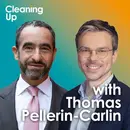
This week Cleaning Up is back in Brussels, with a deep dive into European energy policy as the continent grapples with the reality of ambitious climate targets, very high energy prices and the vulnerabilities of first Russia's attack on Ukraine, and Israel and the US's recent attack on Iran. Michael Liebreich sits down with a rising star of the European Parliament, Thomas Pellerin-Carlin, for a timely conversation at the intersection of energy, geopolitics, and climate strategy.
What begins as a discussion on EU energy policy quickly broadens into a much bigger conversation: a blueprint for Europe’s survival in a volatile world. Thomas argues that the war in Ukraine is not just about territory, it’s about Europe’s future. And one of the main battlefields? Energy. The key to peace, he says, lies in breaking Russia’s ability to turn oil and gas into power, through a global transition to clean energy.
From the inner workings of EU policymaking to the struggle between fossil fuel interests and the Green Deal, this episode dives into:
- Why Europe must electrify for its own peace and security
- The political battles shaping the future of EVs, nuclear, and renewables
- Whether Europe can compete with China and the U.S. in clean tech
- The concept of an “electro-democracy” alliance
- Why energy independence may be the only path to freedom
Leadership Circle:
Cleaning Up is proud to be supported by its Leadership Circle. The members are Actis, Alcazar Energy, Arup, Copenhagen Infrastructure Partners, Cygnum Capital, Davidson Kempner, Ecopragma Capital, EDP, Eurelectric, the Gilardini Foundation, KKR, Mitsubishi Heavy Industries, National Grid, Octopus Energy, Quadrature Climate Foundation, Schneider Electric, SDCL and Wärtsilä. For more information about the Leadership Circle, visit cleaningup.live
Links and more:
- Thomas’ Bio: https://www.europarl.europa.eu/meps/en/256903/THOMAS_PELLERIN-CARLIN/home
- The 130 Trillion-Dollar Man - Ep84: Mark Carney: https://www.youtube.com/watch?v=HtA5ufMzKAU
- The Dane who Harnessed the Wind - Ep139: Henrik Stiesdal: https://youtu.be/7rjuZ_aCsFQ
TPC
That war is not about Ukraine, it is about Europe. That's not only me saying that, it's Sergey Karaganov saying that on Russian TV in December. What we need to understand is we need to have a theory of victory against Russia. We cannot, I mean, nobody wants to invade Russia militarily. But we need to understand what in the military we call the centre of gravity. What is the thing that in Russia, if you remove it, everything collapses.
And that thing is the capacity to turn Russian oil and gas into money. We need to take that away from them. That's the only way to achieve peace in Europe. And that means doing not only a European but a global clean energy transformation. And we need to take that fight, which also happens to be a climate fight, to the rest of the world, because we in Europe will be safer when India will rely more on electric cars and wind power than on Russian oil and gas.
ML
Hello, I'm Michael Liebreich and this is Cleaning Up. And this week we're back in Brussels and we're doing another deep dive into European energy policy as it grapples with the reality of ambitious climate policy, very high energy prices and the vulnerabilities of first Russia's attack on Ukraine and now Israel and the U.S.'s attack on Iran.
I'm joined by someone who's been described as a rising star in the European Parliament, someone whose life's fight is to make Europe a true ecological power. Thomas Pellerin-Carlin was on the lists for Place Publique, Parti Socialiste and Réveiller l'Europe, which loosely translates into the Public Space, the Socialist Party and Reawaken Europe tendencies. He has a fantastic background as an energy analyst. Please welcome Thomas Pellerin-Carlin to Cleaning Up.
ML
Thomas, thank you very much for joining us to record this episode here in Brussels.
TPC
Thank you for the invitation.
ML
So, let's start where we always start, with you describing what you are, who you are, in your own words. Obviously, there is the short introduction that I always do, but in your own words could be interesting.
TPC
Well, I'm Thomas, I'm 36, I'm born and raised in Normandy. I am now serving as a member of the European Parliament with the Social Democrats, dealing mostly with the energy, industry and climate. But before that, for about a decade, I was mostly working as a researcher and on top of that, I was serving in the French army as a reserve army officer.
ML
OK, so we've got energy and we've got military. And that's an interesting conversation, at least clean energy and military is quite an interesting conversation that we can have, particularly as we record this. I think we're in the beginning of week three of the US-Israeli attack on Iran and Iran's escalating response in the region. So, plenty, plenty to talk about. But let's just dig in. When you say you were a researcher, that was mainly with, so you've been a lecturer with the Sciences Po, but you've also been a researcher with the Jacques Delors Institute, is it? It is the Institute, yes.
TPC
Yeah, and my last job was to be a research director for the Institute for Climate Economics, which is a spinoff of the French National Promotional Bank. So the French public bank that provides funding for big projects.
ML
OK, so you've done, I'm going to guess, about 10 years of really detailed energy stuff. Right. But it's been research. It's been… I have to do this without being rude. You know, it's wonkery. It's the stuff I do. It's the stuff that I love. But then you decided, did you always want to be an MEP or is this and this is, you know, you're still kind of early on in the stage. Is there a later stage? What's the ambition? What's the pattern here?
TPC
Well, I mean, the honest truth is that when I was a teenager, I was interested in politics. I'm coming from a working class family. I know that a lot of my family members would not be alive if the welfare state was not created. I know my dad probably would not have been a job, would not have had a job if the welfare state had not been created. So I was very much a political citizen even before having the right to vote.
But I became extremely disappointed, even at a young age, by political parties in France. And so I was like, OK, let me focus on research and military. That's another way to serve the nation. And this changed three years ago when two people who are actually still MEPs today, Raphaël Glucksmann and Aurore Lalucq, reached out to me and asked me to leave my job as a researcher and go into politics.
ML
And those were the founders of the Plave Public trend. Now, what we're going to have to do, we need to take a step back a little bit before we dive into either the situation in the Gulf or energy policy or anything and explain. And I'm going to say, again, the short version of how does energy policy happen or energy regulation and policy, how does it happen in Europe? I mean, I suppose you could do Europe, France and Normandy, because we often on this show, we'll throw terms. We're not allowed to use acronyms, but we will use terms like FIT For 55 or Refuel EU or the European Commission or the Energy Commissioner. But then, of course, you've also got at the national level, you've got policy and so on.
And I don't think we've done a good job yet, even though we've had Dan Jørgensen, European Energy Commissioner, on the show and quite a few very eminent, a number of eminent figures. We've never really explained how the Rubik's Cube gets turned. So how does the Rubik's Cube get turned, Thomas?
TPC
So the European Union has essentially four main tools to try to transform the energy system. Let me take the example of the electrification of cars. I think it's a good one for that. The most intensively hard law stuff that you can do is an EU regulation. It's a law. When it's in a regulation, it passes through parliament. So MEPs, members of parliament that are directed by the people. It also passes through council, where it's the national ministers of the EU member states that are sitting. And when they agree on the regulation, the regulation becomes the law of the land for everybody, whether you're a state or a citizen or a company, you need to respect the EU regulation.
The second tool that we have is also a legislative one, but it's a directive. It works a bit differently. The directive is the European Union. So let's say the confederation level that is ordering the states to do something, to achieve an objective. So for instance, on the charging points for electric cars, back in the day, the directive would be saying member states, you need to achieve that level of access to charging points. And then it would be up to the member states to choose the policy they want to have. You want to do that through regulation. You want to do that through investment, incentive, carbon price, whatever. You just need the member states to reach and to obtain the objective that was set by the EU.
Then you have the third tool that the EU has, which is investment. So the type of public investment you can do, equity, subsidy, loans, guarantees, counter guarantees, you name it. The EU toolbox now is full. And that's what the EU has been pushing forward now with the battery booster, which is essentially a very late EU reaction to the US Inflation Reduction Act. And where we try to put a little bit of money on the table — like too little, too late, but still — in order to provide an economic incentive to have battery manufacturing in Europe. And then the fourth thing that we can do at the EU level is more, it's softer. It's one sometimes people in Brussels call the enabling tools.
So we say, I'm a politician, I've got a role, I'm going to gather people around to try to create some kind of consensus of where we want to go. And that's when, for instance,Maroš Šefčovič, who was a commissioner like 10 years ago, very much a Brussels guy today, he was the father of the European Battery Alliance. And at the beginning, the idea was to put people around the table that would not really talk to one another. Here, we're back in 2016, 2017, so a decade ago now.
And essentially, you wanted the mining company to talk to the battery manufacturers, to talk to the OEMs, so the car manufacturers, to talk to the recycling company, with the investors being there to make sure that everybody a decade ago could say, OK, there is a future in Europe for battery electric cars. That's what we need to do in terms of mining lithium in Finland or in France. That's what we need to do in terms of battery manufacturing, recycling, all the rest.
ML
That is incredibly helpful. I wish I'd done that many episodes ago, because you've got these four levels, regulation, directive, investment, and then enabling tools. And what I'm now going to do is every time we mention one, I'm going to ask, oh, what is that? What is Refueling EE? Or what are the RFMBO, Renewable Fuels of a Non-Biological Origin… What is that? What type of a mechanism? But just, if we could, each of these, not each of them, not all of them, but regulations, directives have to be translated into the member state laws. Or are regulations just immediately in force?
TPC
So that's the difference. A directive needs to be implemented in national law, meaning that if you are a company, you only need to respect national law. You don't need to respect the EU directive. That's up to the member states to respect that. A regulation, it's classic federal law. So a regulation, when it enters into force, it applies to everybody.
ML
OK, so regulations don't have to be translated, but directives do. So maybe we do it like a rapid fire round. So EU ETS, the emissions trading system, is that under a regulation or a directive?
TPC
So it's a bit of a tricky thing. On some elements, we have some elements of the legislation that are under regulation and some others that are under directive.
ML
So how credits are given out, I think, is a directive, whereas the fact that there is a trading system is a law. It's a regulation.
TPC
You know what? I don't want to say anything, so I would actually need to check that, to be honest.
ML
But you've been the prof of this stuff for 10 years or maybe not the prof for 10 years. And so you're just worried that some of your former students are going to be watching and they're going to be writing in saying he's not correct and so on. OK, but then when we get to things like Repower EU, what is that? I mean, it comes up, it gets talked about as this sort of juggernaut of a thing which now, by the way, can't be changed, which has got its own issues we'll get on to. But where does that sit? What was that? What is that?
TPC
By itself, that's not really something that has a legal implication by itself. It's more a slogan that you would have to announce a package of measures. Some of them would include investments. Some of them would include a regulation. Some of them would include directive. It's a little bit like the Green Deal.
ML
So on top of all these four, there's something called a slogan, which is more important than all of them.
TPC
Well, more important, I don't know. But so if you remember, like back in the day, we had the Green Deal. Even before that, in the European Union, we had the Energy Union. And so those were, if you want, a common narrative. But the practical translation of that narrative would be that specific regulation on electricity grids, that specific directive on energy efficiency.
ML
So if you could, what are the most important of those sort of overarching? Well, you can either do an overarching or an individual regulation or directive. If you look at the situation today, what are people working on and to? Because the European, as you say, the Energy Union, I don't think it kind of fell away, but nobody talks about it anymore. It's moved on. So what has it moved on to?
TPC
It's a bit difficult to say, to be honest. So it's funny. I'm still teaching, even if I'm an MEP. So I kept one course, the course that I've been giving at Sciences Po since 2019. And in the introduction to that course, I'm doing the history of EU energy policy. And in 2019-2020, I created a new slide for the Green Deal. I was like, this is the fourth phase. And now I've been, I've had to, you know, walk back my statement because currently, Brussels is dismantling part of the Green Deal, part of the Green Deal regulation. So to me, what has been lacking over the past 18 months is a sense of purpose and direction. Where do we want to go?
The Green Deal had a very, very clear vision, which I think still holds true today, I would say is even more true today with rising oil and gas prices than it was before. But what we've been seeing since 2023 is essentially the diesel lobby and the fossil fuel lobby fighting back, using some elements that are true, real obstacles that we are facing, but also creating, you know, fake information from time to time in order to fuel a fossil fuel nostalgia and a rollback of the Green Deal. And that's, to me, the biggest challenge that we have. And what I hope we can clarify in the coming weeks is to say that essentially, our climate interest, our economic interest and our geopolitical interest are actually aligned.
ML
OK, so at the moment, if I understand that right, we're still sort of largely under the Green Deal, but with this pushback and a relaxation. But the Green Deal is then not a regulation or a directive or an investment framework or a soft power, the enabling tool set. It's in that kind of fifth category of the slogan or the or the bundle. I don't know what. OK, so if that's right, but that is now being relaxed, but without a vision for what to do next.
And by the way, in the UK, it's not like we have complete and utter clarity. So I have described energy policy in the UK. There's a word, a midden in archaeology. A midden is where everybody chucks the rubbish out of a village or town for hundreds of years, maybe a millennium. And then it has layers and there's a bit of everything they've ever thrown away sits in a midden. Of course, when an archaeologist finds a midden, they get terribly excited because there's and we have a bit of feed-in tariff and a bit of renewable obligation certificates and a bit of accelerated depreciation and a bit of R&D funding and a bit of contracts for difference and so on. So that's what ours looks like. And I think there's an element of that here as well.
TPC
I would actually disagree with that for the European Union, at least. Let me take the example of electric cars. We had a legislation. So originally, I think it was already back in the 90s, if not the noughties, we wanted to reduce the climate impact of cars. And at the beginning, it's starting with an enabling tool. It just started actually by working with car companies and saying, can you guys make sure on a voluntary measure that you can decrease the amount of emissions of the new cars that you are proposing on the market?
Obviously, like many things that are strictly voluntary, like it did not work. And so it was around 2006-2009 that the EU came up with the first CO2 standard for cars regulation with penalties for car manufacturers that would not be implementing that. And that regulation has been updated regularly. And the last update was agreed upon in 2023. And this is when the EU, like the UK or California, decided to say that by a specific year, 2030 I think for the UK, but 2035 in the European Union, the only new cars that could be sold would be zero emission cars, which with today's technology are NMC and LFP battery electric cars, essentially. But tomorrow could be with new battery chemistry. Theoretically, it could be hydrogen, theoretically. But I mean, theoretically, it could be anything that doesn't have any tailpipe emissions.
So that was agreed in 2023. And right after that, there was a push to reopen that regulation and to either dismantle that or really reduce the ambition of that regulation. This came as a result of a German fiscal policy decision. Because after we have that agreement in 2023, there is a problem in Germany.
ML
the constitutionality of some of the spending.
TPC
Yes. So the Bundesverfassungsgericht, the German Supreme Court cancels a 60 billion investment plan and a lot of that, including subsidies for electric cars. And so the reaction of the German government was to cancel from one day to the next, a battery electric car subsidy, which was around 6,000 euros, which is a lot.
ML
Per car.
TPC
Per car, yeah. So something quite significant. And so obviously in 2024, the German battery electric car market tanked by something like 10%. And then this was used by a lot of diesel companies to say, look, battery electric cars can't work. And therefore we need to dismantle either everything or most of it, depending on which segment of the business lobby was doing the lobbying.
To me, what is important is to be able to stay the course. Sometimes you need to take, like if there is a shortcut you can take to go faster, let's do that. Sometimes there is an obstacle you need to take a little bit more time. You need to go a different way. I'm all in favour of this. But I want us to make sure that we stay true to the course that we've chosen, not only because I think it's good for politicians to actually implement what they said, but also because we need to face the geological reality. The geological reality is that we don't have oil in Europe. We import 97% of our oil. And unlike the US, we don't have the willingness nor the capacity to invade Iraq or any other country to seize the oil. So we don't want to do that.
And we don't have the capacity to do that. And by the way, that's a very, like war is bad, like that should be the starting point. Sometimes it's a necessary evil, but it's something we should avoid to the greatest possibility. So for us Europeans, the only way to be prosperous and to be free is also to go electric for cars, as well as many other technologies where we still over-rely on fossil fuels.
ML
We'll come back in a second to the vision for how you kind of go around the obstacle and move forwards. But there is not just the acronym rule on Cleaning Up. There's also hydrogen bingo. And that is that the first person who uses the word has to buy the drinks. So you use the word hydrogen. But it is also an illustration of what I refer to as the midden, where there are what should be or are in a sense discarded policies, discarded goals.
And let's be absolutely clear. You know, when I come to Brussels now quite frequently, when I come to Brussels, I don't find anybody who's trying to do 20 million tonnes of hydrogen. I don't find anybody who really wants to build hydrogen fueling stations on roads. I don't find anybody really who wants to build even hydrogen pipelines. And yet, as an example, in the grids package announced at the end of last year and communicated early this year, there is 1.2 trillion euros of intended, planned, I think it comes under partly investment and partly it's an enabling tool discussion to get private money in. But 1.2 trillion of electrical grids, 720 billion of that should be distribution grids. But there's also 240 billion of hydrogen pipelines in there. And it feels like that should truly be in the midden.
And yet it is, you know, which means that every country has to have a team working on hydrogen pipelines or working on. And there's this, you know, hydrogen in AFIR. I'm going to break my own rule. I don't know what it stands for.
TPC
Alternative Fuel Infrastructure Regulation.
ML
So it's a regulation which is difficult to repeal or move back. And yet we've got it. So there is just but the point is actually broader than hydrogen. The point is about nimbleness and speed. Things happen. Invasions happen. Science happens. Learning about technologies happens. Political pendulums happen. Germans discovering what their constitution means in terms of ability to subsidise things happen. And then I come here and everybody says, well, it would be lovely to respond. But unfortunately, you don't understand the four levels and the this and that. So isn't, I suppose, before we get on to what your vision is, I want to finish off on the political framework piece. Isn't the biggest problem here actually that Europe or the EU is just structurally going to be very slow?
TPC
Yes and no. Which, by the way, as we say in French is a very Norman answer. Yes and no. Let me maybe start with the yes part. Yes, it takes time for the European Union to agree on a few stuff. It takes weeks, months, one or two years, maybe three years, depending on the topic. Sometimes we can go very fast. I was the leader social democratic negotiator for the EU regulation to stop importing Russian gas. We had the proposal of the commission in June and we had the final agreement in December. And in Parliament, we consolidated our position in only three weeks. Then we had to wait for the others. But anyway, that's the fact of life.
So can the EU go faster? Yeah, of course, from time to time. Should we? There is also a moment where we should not rush too much. For instance, on the hydrogen strategy, I think we did rush too much. Sometimes it's better to take a good decision after two years than a bad one after one. The thing where I think the EU is actually much better than many other democracies or has been better historically is to provide predictability. So to me, I think if you want the USP, the unique selling point of the EU in that world is to say, yeah, we're a little bit slow, but we are very predictable. And you know that when a regulation is being adopted in the EU, it will be implemented. We might do minor tweaks, but nothing major. We will not do U-turn like what we've seen in the US. And I think that could be, if you allow me to use that metaphor, I want the EU to act more like an elephant. Yeah, it's a bit slow. We need to understand that that's who we are. But we're smart. We're strong. We are not an aggressive empire, but we are ready to defend ourselves if we are attacked. That to me is the attitude that we need to have.
So when it comes to energy policy and the car regulation, for instance, I'm like, okay, let's look at the situation. Let's look at the evolution of the technology. Are battery electric cars cheaper now in 26 than they were in 23? Well, actually, yes. Is oil more expensive now than in 23? I need to check. Probably the same price. But we know that we've been having regular fossil fuel shocks. And so that hopefully will lead my colleagues to understand, or at least to agree rather, because they do understand, to agree that the best way forward for the EU is not to do a Trump thing. It is to continue on the path that we've set for ourselves that is the right one, but we need additional elements. And one of those elements is social leasing for battery electric cars in order to make sure that battery electric cars are accessible for the working people, which they have not been so far.
ML
Let me come back to the example you gave of the decision to get off Russian gas. You said, we decided in June, it was done by December. So first of all, I don't know what the number is, but that's probably 20 billion, 30, 40, 50, maybe, I don't know how many billion of money that went to a country that is attacking an ally and a potentially future member of the EU. But here you are now in year five of that war, and you still have EU members who are obstructing the will of the majority of the countries in the EU and pretty blatantly acting on behalf of a country that threatens the security of countries in the EU, never mind countries like Poland and the Baltic republics and so on, never mind our close ally and future, the EU's future member in Ukraine.
That would not be tolerated in many functioning democracies that one province, and I can't imagine that would ever happen in the UK, where one of the home nations would say, sorry, our ally is a country that's hostile to the UK. And that would not go very far. But here we are in five years. And that is what's happening.
TPC
So the EU is not a super state, the EU is not an empire. What the EU is, is it's really the first time in human history, where we have what the Greeks would call a demoi-cracy. So, you know, the word democracy, of course, comes from the Greek demos, which means one people, demoi is the plural. We try to have one single power, one single Kratos, with a plurality of nations. The French are not like the Germans, the Portuguese are not like the Europeans. And yet we've managed to vote together at the same time every five years from the same year in Parliament.
When we work in the European Parliament, we're working based on our political belief, not based on nationality. I'm closer to my German and Greek social democratic colleagues than to far right, pro-Putin, Jordan Bardella, even if he happens to be French. And what we've been doing is actually unique in human history. I really have no example whatsoever of this. And this also means that we are not a state, we are a confederation, and we need to be able to manage the differences. We've been working time and again, sometimes we fail, sometimes it's only a delay. But still, we've done a lot. Like here again, I'm going to Ukraine every year, we've not done enough. We've done too little too late.
Whenever I'm in Ukraine, it's always a very humbling experience. Because you talk to people, especially in the energy world, they have colleagues who died. If I remember correctly, the CEO of Naftogaz died recently, as a result of a Russian attack. So we've done too little too late. But we've done a lot, let's be clear. We've done far more than the US, even if the US is a super state. And if Ukraine is able to stand today, and to wage that fight for freedom is obviously first and foremost, because of the bravery of the Ukrainians. But the second element is the constant EU support. Insufficient, too late on many things from weapons to energy support to stopping also funding Russia.
Maybe one last point on that, because this is a global thing. What we Europeans have been lacking is a theory of victory against the war that Russia started against us. That war is not about Ukraine, it is about Europe. That's not only me saying that, it's Sergey Karaganov saying that on Russian TV in December. What we need to understand is we need to have a theory of victory against Russia. We cannot, I mean, nobody wants to invade Russia militarily.
But we need to understand what in the military we call the centre of gravity. What is the thing that in Russia, if you remove it, everything collapses. And that thing is the capacity to turn Russian oil and gas into money. We need to take that away from them. That's the only way to achieve peace in Europe. And that means doing not only a European, but a global clean energy transformation. And we need to take that fight, which also happens to be a climate fight to the rest of the world, because we in Europe will be safer when India will rely more on electric cars and wind power than on Russian oil and gas.
ML
Very interesting. Although I don't want to get too much into Russian politics or Russian culture, to be honest, because the thing that really will stop them only, I think, is ultimately the failure of the Russian expansionist model. That ultimately is going to be very hard to withdraw all the sales of oil and gas, because ultimately they can also just route it all east. And so that strategy, I think, would probably fail.
TPC
No, not all of it. So if you look, so this is 2024 data. In 2024, Russia at war spends 140 billion in the military. The Russian oil and gas revenue for that year is 250. So we don't need to have Russian oil and gas revenues go to zero. We just need them to go low enough because we impact the price and we impact the volume that they can sell to make that more economically unsustainable for Russia. And therefore, Putin and whoever will follow might have the same will, but he won't have the same capacity.
ML
I'm not disagreeing about the need to clamp down on their revenues from oil and gas. Let's move back to Europe and come back to you said this is this experiment. It's I'm not sure what was the Greek word you used.
TPC
Demoi
ML
A demoicracy. In other words, multiple demos in a democracy. There's another one. Another great Greek word or Greek derived word, which is bureaucracy. And what you describe with this European structure of lawmaking, it feels kind of, as you say, slow, but predictable and probably better suited for more static situations than than we might have at the moment in energy.
But it's really rubbish at foreign policy. And Europe punches far below its weight. And the problem we've got these days, but particularly these weeks, is that energy is foreign policy. I mean, there's no way of having a view on energy that is not linked to Ukraine, we already talked about, but also Iran. And it just feels like the system is not able to respond fast enough. So we've now got, again, price spikes for oil and gas. My own belief is that the gas one will unwind pretty fast. The oil one won't. But the response in Europe, like an elephant, is something bit me. Where did it bite me? I don't know. Let's have some meetings.
Let's create a task force. And I don't know, maybe we'll create an enabling tool or eventually we'll have some response. And meanwhile, by the way, we'll talk about nuclear, for instance, the nuclear summit, or we'll talk about we'll we'll we'll make fine words as you have, very fine. But the response could be in two, three, four years.
TPC
So let me come back on the foreign policy piece. So the EU, just like any democracy, has a different method depending on the policy area. Most of what we've talked about today, you and me, are really about domestic energy policy. We talk about electric cars, but I could say a lot on renewable energy, on energy efficiency. And when it comes to that kind of European domestic policy, the procedure is essentially we need to have a majority of member states and a majority of members of the European Parliament who agree, just a majority. On foreign policy, because it's, let's say, closer to the Westphalian state, you know, priorities, what we need to have is unanimity. It means that we need to have the 27 member states agree on the same thing. And so that changes the dynamic. And so essentially, you can have one that justs veto things.
ML
And Wallonia separately, half of Belgium separately, I understand.
TPC
Well, let's not go into Belgian politics. That's another kind of form. But that's the way it is. I think moving forward, we need to reform the EU treaties to become more federal and very much in favour of what Jacques Delors called the Federation of Nation States. If we want to survive in this world of bullies, we Europeans need to be more united, need to be more federal. This will however take time, and especially take an understanding on the part of the European elite, because the people are not the problem there. The people are very much in favour of this. It's the national political elite that are against, but they need to understand that against Putin, against Trump, with the rising power of China, with our dependency on foreign tech, we really need to make sure that the EU becomes more united because otherwise we're going to disappear.
ML
Does that mean expelling the nations that don't want that? I mean, right now, okay, we don't know what's going to happen in the Hungarian election, which as we film this, is still a few weeks away. But a country like Hungary would never, the leadership in Hungary would never agree to cede its power to make foreign policy decisions to the EU, not in the current scheme. And I think you could say the same with Slovakia. And I mean, certainly, when the UK was a member, the chance of that was zero.
TPC
It's interesting because, as you just said, a lot of people approach that as a member state ceding or transferring sovereignty to the EU. I think we need to look at the world where it is, like most of the national member states, what they have is the illusion of sovereignty. You are not generally... I mean, for me, sovereignty is not, I can make a decision. I want to have a real impact on the real world. And I mean, don't get me wrong, like, I love my country. I've served the French army, like France. France is a great nation because of its culture, what it brought to philosophy, its food also. But if we look at the population, we are like, I mean, if you take France, Germany, and Italy combined, it's the population of Uttar Pradesh in India.
So the European nation state worked very well for a couple of centuries when the world was dominated by Europeans. It's no longer dominated by Europeans, which is a good thing, to be clear. Now we are in a situation where global powers are China, the US, others. And the only way for us to protect our people, to protect also our national diversity is to be able to act together at the EU level. So what I want national political leaders to understand is that this is not about transferring sovereignty. It's about abandoning the illusion of national sovereignty to have the genuine capacity to pool sovereignty at the EU level and to make the big decisions.
Coming back to energy, like if you want to have a battery value chain, it needs to be EU. There is no way for one single member state to be able to have that. We need to cooperate together because the mines are in some places in Europe. The know-how is different in other places. The investment capacity, a lot of that is actually outside the EU and we need to attract it here. So we need more European unity if we want to be able to deliver on freedom, on prosperity, but also on the climate agenda.
ML
Cleaning Up is proud to be supported by its Leadership Circle. The members are Actis, Alcazar Energy, Arup, Copenhagen Infrastructure Partners, Cygnum Capital, Davidson Kempner, EcoPragma Capital, EDP, Eurelectric, the Gilardini Foundation, KKR, Mitsubishi Heavy Industries, National Grid, Octopus Energy, Quadrature Climate Foundation, Schneider Electric, SDCL and Wärtsilä. For more information on the Leadership Circle, please visit cleaningup.live.
To keep up with all that's going on in the Cleaning Up universe, make sure you subscribe to our newsletter. Written and edited by my long-time New Energy Finance and BloombergNEF colleague, Angus McCrone, it comes out every second Monday. Angus provides the latest on the episodes we're recording, the events we're hosting, stories we're watching, and what Bryony Worthington and I are up to. To sign up for the Cleaning Up newsletter, visit cleaningup.live.
ML
Thomas, one of the benefits of being on this show is afterwards you get to be an alumnus and we have very eminent alumni, including a certain Mark Carney. And I've just been over in Canada. And would you integrate Canada into that battery supply chain? They've got lots of rare earth metals, incredible skills in materials. Would you integrate them? Or would you say, well, no, they're not in our nation state. We can't possibly. The only way to survive in this world is everybody has to join this federation of Jacques Delors-ian federated something. And I'm sorry, Canada, you're either in or out.
TPC
So in my mind, to me, there are three concentric circles. The smaller one is really the core EU. And then in the second concentric circles, I would say we need to create an alliance of electro democracies, globally. The countries that don't want to become vassals, neither of China, nor of the US, nor of Russia. The countries, especially the democracies, that want to be free and understand that to be free, they need to go for clean tech.
So that means obviously Canada is there, but so is Australia, so is Senegal, so is Chile, so is India, so is South Africa, Ethiopia. I could name a lot of them. Today we live in a world where there is no leader of the free world. Historically, it was the US. Trump does not like freedom, he is destroying actually freedom all over the world, especially in his own country. We need someone to step in. And I think it should be the EU leading there together with the other democracies.
ML
So you want to create an electro democracy. There is one country, though, that you didn't mention, which can do the electro. You could do the democracy in the EU. I hope you will allow the UK to be on the democratic bit of the electro democracy. But there is a country that is, frankly, at this point, much better than all of us at electro, and that is China. So do you say, well, let's do this electro democracy. China does electro, and we'll do democracy, and we'll get closer to China because we don't like what's going on with the petro. What do you call them? The petro authoritarians or the petro states, I call them.
TPC
I would call them the petro dictatorship, to be clear.
ML
Well, I'm going to come in here and say, well, come on, steady. The US has not turned into a dictatorship at this point. You can see some tendencies, and it's extremely troubling what's going on. But that game is not over yet. And the US has flirted with all sorts of extreme authoritarian tendencies in the past and has always managed to pull itself back. We shall see. But I think it's a bit premature to call it a petro state. I can accept the petro authoritarian or petro dictatorship. I have to put a flag down and say, wait a minute, come on, really?
TPC
I did not say that. What I had in mind, to be clear, was countries like Russia, Saudi Arabia, Iran, Azerbaijan there. But maybe answering your point, which is really about China. I think we now have a historic duty as Europeans to be able to be one provider of clean tech for the rest of the world. If we don't do that, 100% of the clean tech will be Chinese. Nearly 100%.
And so we need to have a clean tech base in Europe, obviously for us, for our own sovereignty. But also, because we are not an empire, unlike China or the US, to be able to provide that clean tech and working together with other countries, especially other democracies in the world, for them to have access to another clean tech than just the Chinese. So I'm mindful of the fact, for instance, that the PV modules that Senegal and South Africa will deploy will be Chinese, of course. On batteries, can we at least have a market share in those countries? Probably, we'll see. It depends on what we do.
It will be also in their interest to de-risk from China, to make sure that they have at least, I'm just making up the number here, but like 20 or 30% of their battery imports or their electric car imports or their wind power imports that are coming from Europe in order to de-risk their relationship with China. So I think building a clean tech industrial base in Europe is good for Europeans, but it's also good for anybody who believes in the free world.
The US could have provided this. If we were living under, I don't know, Bernie Sanders or Pete Buttigieg, America, then probably, yeah. I would say if Europe gives up on clean tech, then we will need to choose between the US and China. Now the US, at least at the federal level, has given up on that. And I don't know where the future holds, but I know that when I'm looking at Trump, I'm thinking of the former Italian Prime Minister, Silvio Berlusconi, who has many similarities to Trump, and he stayed in power. He was in and out of power for two decades, maybe even three. And then the thing that came after that was Meloni, which is even worse in terms of freedom and democracy.
So I think we need to be, at least we need to make sure that our future, the future of freedom in the world, does not only depend on what is happening in the US. And one condition for that is for Europe to provide a lot of clean tech solutions for Europe, but also for the rest of the world.
ML
Interestingly, there are, though, two pieces, two preconditions for that vision. One is the clean tech, which has to be dynamic, affordable, world-class, etc. The other, though, is economic dynamism. When you say Meloni is so terrible. But economically, you've got Poland doing well, Italy doing well, Spain doing well, and most of the rest of Europe doing horribly, Portugal, a few other countries. But you mentioned Bernie Sanders as being the sort of, in the parallel reality, you've got Bernie Sanders or Pete Buttigieg. Under Pete Buttigieg, I could see the US potentially doing well, but also continuing with the Inflation Reduction Act, which is essentially the US's attempt to compete with China in clean tech.
Under Bernie Sanders, I can't see any successful pathway for the US under somebody like that. And to translate it into French politics, it's a kind of Mélenchon figure, and surely catastrophic for anything. You could forget clean tech in that situation.
TPC
I'm not the best person to talk about US politics. So if you allow me, I guess the main point I'm trying to make is to say that I'm not sure what the US will do. I need, as a European politician, to focus on what we Europeans can do. What we Europeans can do, we are already very good on a lot of clean tech segments, on electrolyzers, on heat pumps, on offshore wind. We're very good. We're not that bad on electric cars. We're bad on batteries, but we are trying to catch up.
And it is important that we do that for us in Europe, but also that we work with other countries and do that in a way that is synergetic. Europe did a lot of mistakes in its past. When you live in Europe, you inherit from centuries of colonial oppression of free people by Europeans. Some of the people that Europeans oppressed were other Europeans, like the Irish were oppressed by the British Empire. The Poles were oppressed by the Russian and the German and the Austrian Empire. But Senegal was oppressed by the French Empire.
We are trying to build — if I can use that term, it will scare a lot of people, but I will use it anyway — we are trying to build a post-colonial power. And that means we need to understand that we need to work with those countries. To me, I think, for instance, working with Chile means, okay, you guys have the lithium, you have the copper, but you're also a democracy. You have a lot of very good working people. You also have a lot of free trade agreements. What is the kind of global agreement that we can have in order to make sure that this can be a win-win? That means that some of the lithium will be exported unrefined to Europe. Some of it will be refined in Chile and exported to Europe. Some of it will be transformed into batteries and possibly also imported to Europe.
But we need to have that discussion. And we need to make sure that we have that in that multipolar world, that we can have a poll, which is EU plus other democracies that want to reestablish a form of rule of law in international politics. If we do not do that, then we're looking towards a very bleak, bleak world, where we're going to have so much bad investment being made, a lot of suffering and a lot of death, honestly.
ML
Much of that resonates. One of the themes that we are exploring repeatedly during the course of this year on Cleaning Up is what I call ‘most of world’, because a lot of energy analysis is what is the US doing? What is Europe doing? What is China doing? And the fact is that 70 percent of the world's population, 45 percent of GDP, 30 percent of energy investment is not happening in those places and all the demographic growth. And if you look at Europe, not on a Mercator projection map, if you look at it on a globe, you discover that it's this little appendage that sits above Africa.
The big thing, the big story or the big chunk of land, renewable resources, minerals, people, growing demographic is actually sitting south of us. And we have an uncomfortable and unresolved relationship exactly for the reasons that you raised. Because of the colonial period, we have an unresolved relationship. And for the UK, we have an unresolved relationship with particularly India, also Pakistan, Bangladesh, but quite a tense relationship with India as a result. And so that all resonates.
But then I would come back to the clean tech piece. You say that Europe is pretty good at electric cars. I have a, I'm not sure if I should say, Volkswagen ID4. The car is fine. The car is fine. The door sounds nice. I feel safe. It performs fine. The software is I'm sorry, it's unacceptable, unacceptable. The clunkiness, the lack of usability, the user interface, the way that when you're parking it and it spots another car, it slams the brakes on as though you're about to crash at high speed. And just it's terrible compared to state of the art, which in software is still, I'm afraid, Tesla, although I would never buy one.
But also the Korean and the Chinese cars, which are way ahead of what we're producing in Europe. And what saved the UK car industry was Nissan building a great big plant in Sunderland. They were lured in, encouraged to come and do that. And that then enabled the UK to remain a player in European car manufacturing. And there are those who say that European car industry is essentially lost and needs to go to China and get technology and and try to catch up to the state of the art in car manufacturing, which is now China, not Germany, not France, not Spain, which used to produce three million vehicles now produces less than a million, not the UK and so on. Are they wrong?
TPC
There are elements that are too important for us to give up on the car industry, offshore wind, battery. Those are things where we cannot afford to lose the clean tech rates. I want to say that about PV modules, for instance, for the PV inverters, I would say that, but not for the modules.
ML
You mentioned electrolysis. I was very good. I didn't go down that rabbit hole. You said Europe's good at electrolysis. First of all, we aren't. Second, it's irrelevant. But, you know, the same argument, pardon me for interrupting the same argument, we have to be good at would have been made for mainframe computers and it could be made for, you know, the Internet's companies and so on. And the fact is… the Lisbon, there's the Lisbon initiative, which was in 2000. Europe, because it was existential, was going to be the leading and most dynamic digital player in the world by 2010. It was existential and Europe failed. The EU failed. So wanting to be a player in these things is not the same as being a player.
TPC
When there is enough political will and that will leads to concrete actions, we can do a lot. If you allow me to use an analogy, back in the 1930s, France really needed to build a refining business. It was a clear priority by the French government to have a refining capacity in France. And they managed that through trade policy. They had very low tariffs on crude oil and very high tariffs on petroleum products. And a lot of the refining industry we still have today in Normandy, where I'm from, is actually coming from investments that were made at that moment.
They were mostly private investments, by the way. In the 70s, when we faced the first oil shock, we said we need to stop burning oil to generate electricity. And that's the moment where France, but also Belgium and Sweden and West Germany invested a lot in nuclear. And the nuclear power plants from the 70s and the 80s are still very helpful today to provide a lot of cheap and decarbonised electrons to Europe. The Danes in the 70s invested in wind power. Who in the 70s believed that wind power would be such a big thing half a century later?
ML
Another alumnus is Henrik Stiesdal, which is exactly who believed in it and designed the first three-blade wind turbine. So you're in eminent company here.
TPC
So to me, what we need to do politically is to say those are our values. This is the world we want to have. Then the concrete action is that we need to collectively as a society invest in a portfolio of technologies, knowing that some of them will not work or will not work here, but will work elsewhere. But making sure that that portfolio is diverse enough for us to have enough successful bets that turn out to be profitable. So that's the way I'm currently looking at things.
ML
But if you look at a great example to say, okay, we needed refining and so we did these things and we got refining, fine. But right now, if you talk to chemicals companies, if you talk to metals companies, the rare earth or the metals and minerals that you need for all of the above. So you look at the steel industry. Can we do this without a steel industry in Europe? And I don't think just recycling using electric arc furnaces really counts as the same sort of steel industry as India has or China has or other countries.
Our energy costs, what's stopping it is almost the end point of what you want is clean energy, I think you're going to say, that is affordable and resilient, which would enable those industries to flourish in Europe. But right now, you don't have that. What you've got is very expensive energy because we don't have cheap, clean energy and we don't have cheap fossil energy. So we just don't have cheap energy of any sort. And does that not act as a roadblock to all of the dreams, all of the plans, because we're just not a good location to make stuff with an energy cost problem. And by the way, we can talk about AI where we're clearly behind the curve. So what are the cards? What are the cards that we play to play our way into the position that you want to see us in?
TPC
To me, clearly, for Europe, the way forward is electrification through renewables and nuclear. If you look at the price of oil and gas, oil and gas in Europe will always be more expensive than in the US, just because they have oil and gas and we do not. So we can never out-compete the US, but many other places, by the way, we cannot out-compete them through oil and gas. Essentially, now, since the 2021 Russian decision to decrease gas supply to Europe, we Europeans are living with Japanese-level prices of gas.
When it comes to electricity, the decision is actually interesting. A lot of people in Europe are saying that the EU electricity price is higher than the US electricity price, which if you do the average is true.
If you go a little bit more granular, because there's no such thing as a US electricity market, you see differences. So if you look at the market price, so you take Texas and New England on the US side, and you take France and Northern Sweden, for instance, or Germany in Europe, what you see is that there are already some areas in Europe that are cheaper than some areas in the US when it comes to electricity cost. And to me, that's the proof of concept of the fact that going towards electro democracy is the best way forward for us.
How do we do this? We need to deploy much more renewable energy, clearly in Europe. We need also to have an incentive for energy efficiency. We need to provide predictability in order to decrease the capital cost. Because we know that one of the big reasons why the transition is costly is because it's more capex intensive. And the way we make it more profitable, or at least more economically optimal is to decrease the risk and therefore decrease the capital cost. So we need to do all of that.
Then at the end of the day, what we will realise when there will be another gas shock and another oil shock is that we will be much more resilient than other economies towards the oil and gas shocks that are likely to become more frequent as the world becomes more unstable.
ML
I discussed this with Nikos Tsafos in an earlier episode. He was at the time a researcher, an academic, an advisor. But then in between recording the episode and it being released, he became the Deputy Secretary of Energy for Greece. And I was probing him about this idea that a plan like you described, more investment, more renewables, more supply. And we talked a lot about transmission to equalise, because you had these different areas in Europe. Some were expensive, some were cheap.
And I was probing there what the cost of that could ever be, because in the end you have lots of wind in the north of Europe and not much sun, which means during the winter you're using a lot of wind. That's your big resource. And then in the south you've got wind and you've got sun, but then there are times when even in the south in the winter you'd have a resource shortage. So the only way to make it work is transmission between the two, but also over capacity, because there are times when there's no wind in the north, so you've got not only a transmission grid from the south, but the south is powering itself and the north.
And then there are other times when the north is having to make up for a shortfall in the south, so the transmission is being used in the other direction, but you've got to have over capacity in the north. And then you've got the same east and west. And so I was just finding it hard to see how you've got resources that cost, in the case of offshore wind, 70, 80, 90 euros per megawatt hour. You've got to do massive over capacity, because you might be feeding it to some other region at some point, and you've got to add on top of that these immense investments. And we had Tim Meyerjürgens, CEO of Tennet Germany, and also John Pettigrew, CEO at the time of National Grid. So you've just got these absolutely gargantuan investments.
So can you do it as engineer? I'm an engineer, I love it. The idea of a copper plate Europe, the power from anywhere to anywhere with marvellous clean technologies, which I've spent 25 years tracking and so on. But how can you ever compete with a country that just says, we're just not going to do that? We're going to use, and they've got a country with gas like the US, or a country with coal that is not on an accelerated route to match tonne for tonne the carbon emissions per megawatt hour. How do you win? Or do you just say, well, we're not going to win on energy costs ever, ever again?
TPC
To me, there are three elements, there are three partial solutions where if you combine them, fix, I think most of the problem. The first one is actually nuclear. We have, still today, nuclear is depending on how you count, like either number one or number two power source in the European Union. We have a lot of legacy nuclear that we need, from my point of view, at least that we need to continue as long as nuclear safety and engineers tell us that it's safe to go forward. Back home in France, my party is one of the few left wing party that is supporting the buildup of new nuclear power plants to make sure that we will also have nuclear in the second half of this century.
The second part of the answer is flexible demand. Anything that can provide flexibility to the system through demand is great. Heat pumps, cars, electric cars, but also other elements. I think heat storage is interesting. Industrial heat storage could be interesting because it's easier to store heat than it is to store electricity, as we know. And so if you can have a brewery or a cheese factory, to take very Normandy examples, that is able to stop consuming electricity for a couple hours a day, maybe a few days a week, because it has stored heat. You have an interesting element that allows you to provide flexibility.
And the final thing is to co-locate supply and demand. How can you do that? Mostly, especially through the industry. And that's something we've done in the past. In the 70s, France was a big ally of the Shah of Iran. The Shah of Iran had a plan for nuclear, civilian nuclear development. And the French company at the time already had built two cuves de réacteur, sorry, I don't know the word in English, but essentially a key component of the nuclear reactor for Iran.
ML
Reactor vessels
TPC
Reactor vessels for Iran. And the Islamic revolution happened. And so obviously, it was no longer geopolitically palatable for France to give two nuclear reactors to the Ayatollah. And so we needed to do something with those two reactors. And they were put in Gravelines, in the north of France, near Dunkirk. And then there was another supply of electricity. And what did the French state do? It teamed up with an aluminium company to set up the aluminium factory that I visited a couple of years ago. And that factory consumes the same amount of electricity as the city of Marseille, which is one of the biggest cities in France.
So we're talking 1 million people, more or less. And so that's the thing where we can try to intervene. That's part of the so-called European enabling tools to look at the areas where we know there is already a lot of decarbonised electricity. We know we can bring more electricity cheaply there because essentially, we're close to a lot of wind power potential or whatever, and see what we can do to make sure that we co-locate them. And by doing this, we obviously achieve electrification and decarbonisation, but also at a lower cost because we need a much smaller grid for that.
ML
So the Dunkirk example is wonderful because you've got a battery factory there that's being built, Verkor, very under the radar. I don't know how many of my audience will even have heard of it, but I'm watching it very carefully and I've been invited to visit. I also know that it's a fantastic location for data centres. And I'm working with a team that would very much like to talk to whether it's the mayor or the local officials there, because it is interesting. It is an energy super island in a way.
I want to come back just to your first one, partly because of the Normandy connection, Flamanville, the famous French power station, which is not the most disastrously over-budget nuclear build in the Western world, but it is only beaten by other EDF developments like Hinkley C in terms of the budget overrun. But I mean, Flamanville, we're talking about something that was supposed to take four and a half years that has taken 18, four times as long.
It is cost by some accounts by the French Cour des Comptes, the national auditor, seven times as much as budget. Are you going to be able to beat, are we, Europe, because we have our own national champion, Rolls-Royce and others, but is Europe going to be able to beat China on nuclear cost, on the cost of nuclear electricity, where China right now is probably building nuclear at something like 30% of the cost of what we're doing in achieving in Europe?
TPC
Maybe first let me talk about Flamanville and why it was so costly. The main reason why it was so costly is because the company had to start from scratch. France was very good at building nuclear power plants through the 70s and the 80s and the 90s, and then it stopped. And therefore, all the know-how, the entire value chain, all the SMEs, the suppliers, they were all gone. And therefore, we had to relearn there. And therefore, you're looking at a cost that is closer to the cost of a demonstration project, if I can use that example, rather than the cost of something you will build in a way that would obviously be commercially viable. When it comes to China, I mean, we need to be mindful of one thing.
We cannot surrender our entire industry into Chinese hands. We simply cannot afford to do that as Europeans, otherwise we will lose our freedom. One element on which I've been working on is what, now in Brussels, we talk about this as the Made in Europe. It's a little bit like the US has a Buy American Act to have a Buy European Act to make sure that we are mindful of the fact that on some strategic areas, and nuclear is definitely one, we need to have European technology with European components. Nuclear is definitely one there.
So, the real question will not be about Chinese nuclear in Europe. I think we should not have Chinese nuclear in Europe. Chinese investment in elderly care in Europe and in highways, all fine, but not in nuclear. Let's be geopolitical for once.
And then the question will be, will we be able to export nuclear outside of Europe? That is obviously an open question. We need to make sure that has a value proposition. One thing that we've been lacking though, on nuclear, but also on clean tech more generally, is public support to exports. One of the reasons why China or Russia are able to sell nuclear power plants doesn't only have to do about the technology, but it's also because they come with a financing package to de-risk investments.
And we know that for nuclear, but also for offshore wind or building renovation, the cost of capital is critical. And that's something where we've not done enough in Europe. We really need to decrease the cost of capital, both for the projects that are happening in Europe, but also for what we can export to the rest of the world.
ML
The conversation about the reasons for Flamanville and Hinkley and so on, the cost overruns is a fascinating one. I think I need to do a whole episode or two because the problem with the thesis that, oh, well, it was an out of date supply chain and skills, is that we're now onto Sizewell C. So, there's one reactor in Flamanville.
I think there's three being built in Hinkley C, three more now. And Sizewell C, 43 billion pounds for, I think it's 3.2 gigawatts of nuclear. I mean, the costs are not, despite having moved a lot of the financing costs into a regulated asset-based model, they're just not coming down remotely fast enough to be competitive. So, I worry.
But the other piece of nuclear, perhaps we will need to draw to a close or finish on, small modular reactors. We just had the nuclear summit and Ursula von der Leyen spoke, again, very eloquently about the absolute necessity for Europe to be a player and to take it seriously. Europe is spending something like 10 billion euros in the next budget round, 2028 to whatever it's going to be to 2033-34. I think it's 9.5 billion euros earmarked. But more than half of that is fusion, which is being poured into the black hole that is ITER in, not in Normandy, but in the south of France, in Cadarache, in the south of France.
And so, by the time you slice and dice from fusion, from nuclear, you remove fusion, you get fission, and you remove the support for the existing generations of technologies. The numbers that get bandied around coming from Europe to support the small modular reactor programme are 200 million euros here, 200 million euros there. I mean, there are individual private equity investors in the U.S. that put in three, four, five times that into one model of one potential SMR technology.
Are we serious enough? Is the EU being serious enough? Or are we just playing around, mixing a little bit of level three investment with a lot of talk about enabling tools number four with a bit of a slogan and maybe in a few years we'll do a directive and who knows, we might actually pluck up the courage sometime in the next commission to do a regulation?
TPC
I guess for non-European listeners, one thing that is important to understand is that Europe is extremely divided when it comes to nuclear. That's not the case in the U.S. and actually in most places over the world, you don't really have political divide on nuclear. In Europe, it's really divisive, especially depending on the national tradition. I'm coming from a country, France, that has a tradition of being a centralised state and where we associate nuclear first with the military and where we associate the nuclear bomb with the capacity to defend your French freedom forever. The nuclear bomb was really, really created as the answer to the fall of France in World War II.
Obviously, German history is very different. The German political ideal is not about a centralised state, it's about decentralisation. I think that political ideal also has an impact on your energy technology preferences. In a way, it's more cultural for French to like nuclear because we love the central state, while it's more cultural for a German to love onshore wind or PV because it resonates more with the political vision.
That is to explain why Europe is a bit dragging its feet on nuclear. At the end of the day, let's look at the numbers. Nuclear accounts for around 10% of the final energy in Europe, around 10%. Two thirds of that is oil and gas. The big priority for us Europeans is to phase out oil and gas. We need to phase it out for our geopolitical survival. Because we don't have oil and gas in Europe, we need to phase this out for climate, for air pollution. We also need to phase it out to protect our economy from the future oil and gas shocks that we're going to have and that we're having today and that we're going to have again in the future.
The answer to this is primarily about efficiency and renewables. You can do more or less nuclear, but really the bulk of the work, you cannot do without efficiency, you cannot do without renewables. At the end of the day, some European nations will choose to have also nuclear, Slovakia, France, Sweden, but others will choose to perform the transition without nuclear. Denmark, Germany, possibly also Italy will go that way.
That's my conclusion. Energy is political by nature, and we need to find an energy system that resonates with the political system. In Europe, we need to be united in diversity. We need to be united when it comes to efficiency and renewables, but we need to accept national diversity when it comes to nuclear.
ML
Yes. Just one question though. You have colleagues, Spanish colleagues, who are still trying to shut nuclear power stations that have got long potential lifetimes. Have we really in Europe not learned that that's a bad idea based on the experience that every country that has done so has seen soaring energy costs, very slow progress on climate goals, fragility of their energy system? What do you say to your Spanish colleagues when they talk about shutting their remaining nuclear plants?
TPC
So 15 years ago, Germany was led by a centre-right politician called Angela Merkel. She led Germany for more than a decade. During her mandate, she shut down 15 gigawatts of German nuclear that could have continued to run. Would we be in a better position if Angela Merkel had not shut down nuclear power plants? Yes, clearly. But here again, at the end of the day, I put democracy and freedom above all, and it is up to the free peoples of the world to make their own choices.
So I don't want France to shut down existing nuclear power plants for a lot of reasons you and I know. I don't think it makes sense from a climate and economic perspective. This being said, at the end of the day, people are free to make their own choices. And so for me, as a member of the European Parliament, I am respecting the national sovereign decisions to go in favour or to go against nuclear.
ML
It just must make for an interesting conversation over canapes after your meetings in the Berlaymont, with the socialist group, when the Spanish are going 180 degrees against point number one of your three-point plan for cheap electricity, cheap, clean electricity, which was nuclear. But I respect your answer.
And I think the interesting thing is there's probably a parallel universe or maybe a parallel podcast where you would be grilling me and I would be arguing that clean energy, not just nuclear, but renewables and also batteries and storage and so on, do offer Europe the only path to its own energy independence, the trilemma, affordable, clean and also resilient energy.
I would probably be saying that the secret has got to be around volume. It's got to be around demand growth, because all of these things are hard when you have to spread these very, very big fixed costs across a relatively modest demand. If you actually had lots of data centres and lots of EVs and lots of electric heating and lots of electrified industry, then suddenly the cost of the grid and the cost of the fixed costs and so on, it just begins to recede. And so that would be probably my answer to how we could possibly get ourselves on the right path.
TPC
And I fully agree with that. To be clear, today, the electricity demand in Europe is declining. We've consumed less electricity in 2025 than we did in 2018. And the share of electrification is not only high in China, but it's also high in the US. And so that also means that we have not fully invested in electrification. And to me, that's really the way forward. And the moment we replace oil and gas with electricity is a moment where we achieve affordability, where we achieve our climate objective.
But here again, freedom. Freedom is under threat in Europe at a level that has never been, at least in Western Europe since 1945. And we need to understand that the only way for us to be free is to produce our energy at home. And since we don't have oil and gas, that means primarily renewables.
ML
Thomas, it's been a great pleasure.
TPC
Likewise.
ML
Thank you very, very much for spending time with us here today on Cleaning Up.
TPC
Thank you.
ML
So that was Thomas Pellerin-Carlin, energy specialist and socialist member of the European Parliament. As always, we'll put links in the show notes to resources that Thomas and I discussed during our conversation, but they are too many to list here. So please go to the show notes and you'll be able to click through to them. And with that, I'd like to thank our producer, Oscar Boyd, video editor, Jamie Oliver, our head of operations, Kendall Smith, the team behind Cleaning Up, all the members of the Leadership Circle without whom none of this would happen. And of course, you, the audience, for joining us here today. Please join us this time next week for another episode of Cleaning Up.
Cleaning up is proud to be supported by its Leadership Circle. The members are Actis, Alcazar Energy, Arup, Copenhagen Infrastructure Partners, Cygnum Capital, Davidson Kempner, EcoPragma Capital, EDP, Eurelectric, the Gilardini Foundation, KKR, Mitsubishi Heavy Industries, National Grid, Octopus Energy, Quadrature Climate Foundation, Schneider Electric, SDCL and Wärtsilä. For more information on the Leadership Circle, please visit cleaningup.live. If you're enjoying this episode, please hit like, leave a comment and also recommend it to friends, family, colleagues and absolutely everyone. To browse our archive of around 250 past episodes and to subscribe to our free newsletter, visit cleaningup.live.


